Dr. Yong-Sam Kim's Team at Korea Research Institute of Bioscience and Biotechnology
[Asia Economy Reporter Kim Bong-su] A Korean research team has developed an ultra-small gene-editing technology that overcomes previous limitations, opening new avenues for treating genetic diseases such as hemophilia.
The Korea Research Institute of Bioscience and Biotechnology announced on the 27th that Dr. Kim Yong-sam's gene editing research team published a paper on this topic online on the 2nd in the international biotechnology journal Nature Biotechnology (IF 54.9).
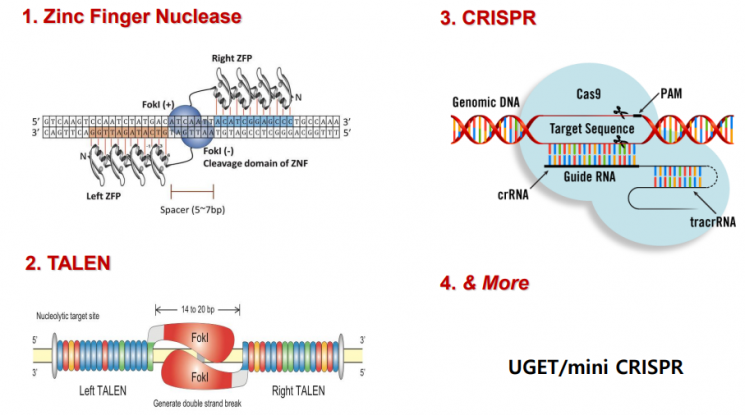
The representative CRISPR gene-editing technology, CRISPR-Cas9, has a large gene size, making in vivo delivery via viral vectors (Adeno-associated virus, AAV) difficult, thus severely limiting its use as a gene therapy agent. Efficient gene editing therapy requires delivering the gene-editing gene into the desired cells, and using AAV virus is the best method for this. However, the gene size that AAV can deliver is limited (4.7 kb).
The recently developed CRISPR-Cas12f1 system is about one-third the size of Cas9, making it ideal as a gene editor for AAV delivery. However, it has no gene editing efficiency and thus has not been used as a practical therapeutic agent.
The research team succeeded in increasing the efficiency of the previously ineffective Cas12f1 system to Cas9 levels by engineering the guide RNA, a core component of Cas12f1. They transformed a gene-editing system that had no editing efficiency for any gene into one with high efficiency exceeding 80%. This achievement was possible by resolving mismatches between the naturally occurring Cas12f1 guide RNA sequences and Cas12f1 itself.
By optimizing five structurally incomplete sites in the guide RNA sequence, they secured high editing efficiency comparable to Cas9. During this process, they reduced the unusually long guide RNA length by 40%, enhancing its suitability as a therapeutic agent. They also demonstrated that the off-target effects (unintended impacts on other genes) were much safer than Cas9, developing a gene-editing technology that combines excellent efficiency with safety.
Through large-scale validation targeting a total of 88 genes, the enhanced Cas12f1 showed higher efficiency than Cas12a (Cpf1) and comparable or even higher editing efficiency compared to Cas9. Additionally, by proposing a new editing method for target sequences with relatively low efficiency, they proved that the technology is applicable to a wide range of sequences.
By identifying the cleavage site of the Cas12f1 system, they demonstrated high persistence, a favorable characteristic for development as a gene therapy agent. Utilizing this feature, they attempted therapeutic strategies targeting the causative genes of genetic diseases such as Leber congenital amaurosis (LCA) and Duchenne muscular dystrophy (DMD), confirming superior therapeutic efficiency compared to EDIT101, a treatment currently in clinical trials in the United States.
Dr. Kim said, "We expect this to lead a revolution in gene therapy using gene editors," adding, "It will contribute to the development of innovative new drugs for various genetic and rare incurable diseases such as visual impairment, muscular atrophy, anemia, and cancer."
© The Asia Business Daily(www.asiae.co.kr). All rights reserved.
![Clutching a Stolen Dior Bag, Saying "I Hate Being Poor but Real"... The Grotesque Con of a "Human Knockoff" [Slate]](https://cwcontent.asiae.co.kr/asiaresize/183/2026021902243444107_1771435474.jpg)
















