Recently Completed Dismantling and Repair Work... Closing Ceremony on the 29th
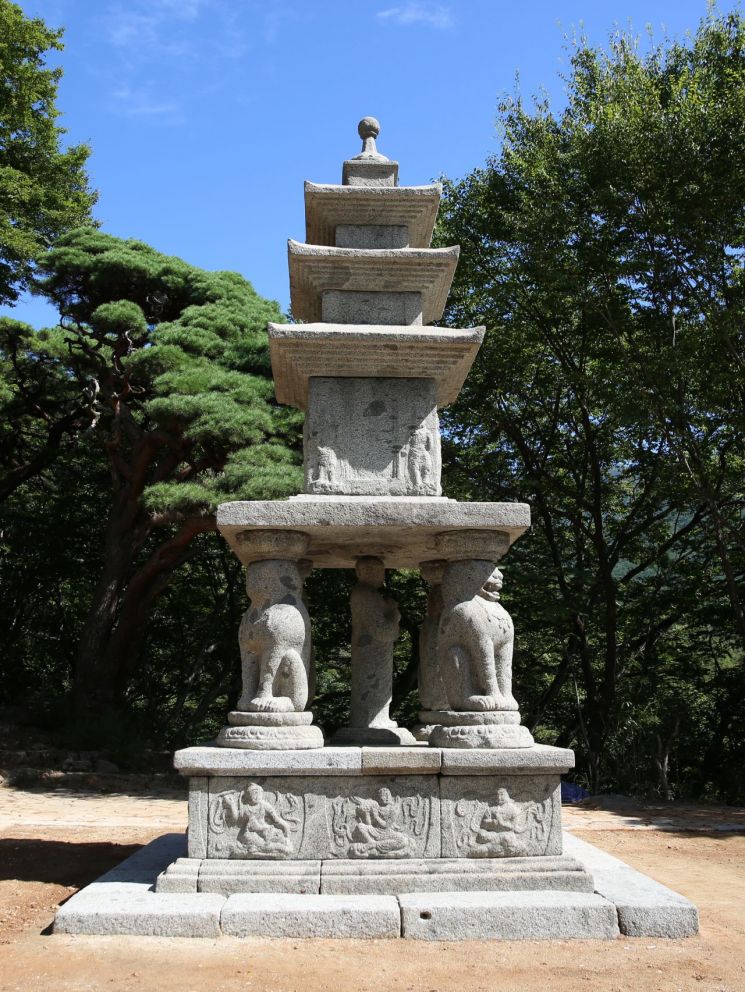
The Sasa-ja (Four Lions) Three-story Stone Pagoda of Hwaeomsa Temple in Gurye, representing Korea's unique style of stone pagodas, has been restored to its original form. On the 27th, the National Research Institute of Cultural Heritage, Gurye County, and Hwaeomsa Temple announced that a completion ceremony for the pagoda will be held at 1 p.m. on the 29th at Hwaeomsa. The Sasa-ja Three-story Stone Pagoda was identified as needing repairs during a detailed inspection by Gurye County in 2011, and dismantling and restoration were decided the following year. Cracks, breaks, and separations were found in the base of the pagoda, which was leaning southeast. It was dismantled in 2016 and recently completed restoration work.
During the dismantling process, the National Research Institute of Cultural Heritage discovered that the pagoda had lost a significant portion of the filling (jeoksim, the earth and stones packed inside to support the pagoda) inside the lower base due to rain and wind. Some stone materials were damaged or deformed, and cracks appeared in the lion statues supporting the load and the upper base capstones. After academic investigation, restoration technology research, and preservation treatment, reassembly was recently completed. A representative from the institute explained, "Most of the original stones were reused through scientific preservation treatment and structural reinforcement," adding, "It is significant in preserving the historical value of the pagoda."
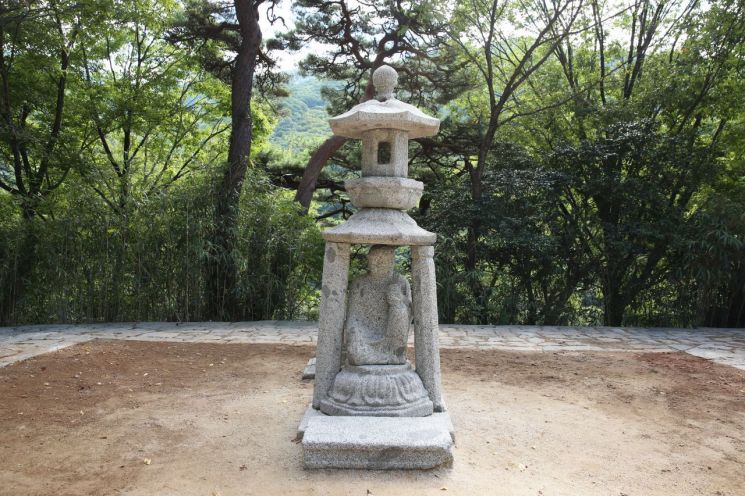
The completed Sasa-ja Three-story Stone Pagoda stands 7.1 meters tall and 4.2 meters wide, weighing approximately 50 tons. It is estimated to have been built in the mid-8th century. It consists of a two-tiered base, a three-story body, and a top finial. At each corner of the upper base are four lions, baring sharp teeth with open mouths. The lower base is carved with celestial beings (Cheoninsang) who convey Buddha's teachings through dance and song, and the first-story body features guardian deities such as the Inwangsang (Guardian Kings), Four Heavenly Kings, and Bodhisattvas. The stone lantern facing the pagoda is engraved with various figures, believed to be Yeongi Josa, the founder of Hwaeomsa, and his mother.
The completion ceremony will be conducted according to Buddhist rites. Attendance will be limited to prevent the spread of COVID-19. The National Research Institute of Cultural Heritage plans to publish a report within the year detailing the research results and restoration process.
© The Asia Business Daily(www.asiae.co.kr). All rights reserved.


















