Korea Federation of SMEs 'Survey on the Utilization and Opinions of the SME Employment Retention Subsidy System'
63.7% of SMEs Respond 'Need to Introduce Korean-style PPP System'
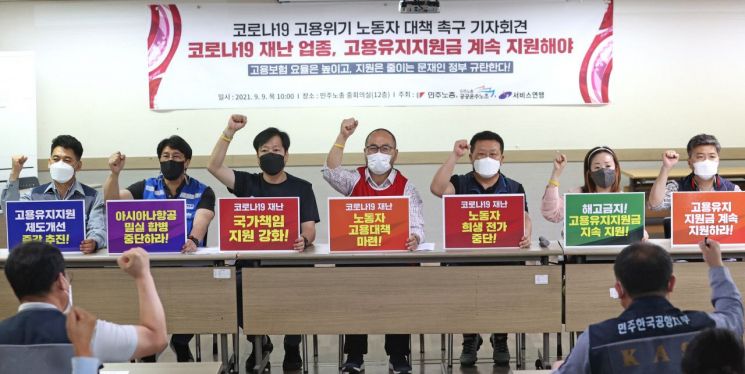 At a press conference held on the 9th at the Korean Confederation of Trade Unions office in Jung-gu, Seoul, officials from the KCTU Public Transport Workers' Union and Service Federation urged the extension of the employment retention subsidy support period. Photo by Yonhap News Agency
[Asia Economy Reporter Kim Heeyoon] More than half of small and medium-sized enterprises (SMEs) using the Employment Retention Subsidy are experiencing difficulties in workforce utilization.
The Korea Federation of SMEs (Chairman Kim Kiwon) announced the results of the "Survey on the Utilization Status and Opinions of the SME Employment Retention Subsidy System" on the 27th. The survey was conducted from the 8th to the 17th among 300 SMEs that had experienced difficulties in employment retention since the spread of COVID-19.
The survey results showed that 61.6% of SMEs responded that they had "experienced difficulties in workforce utilization" when using the Employment Retention Subsidy system. This indicates that under the current system, where receiving the subsidy requires mandatory temporary closure or leave, companies face significant burdens due to restrictions on workforce utilization.
Regarding the types of difficulties faced by companies, the most common response was "the application procedure is complicated" (41.2%). This was followed by "restrictions on workforce utilization and new hiring, and strict penalties upon detection" (36.5%), and "the support period is short" (30.6%).
Among companies that previously used the Employment Retention Subsidy system but are not currently using it, the main reason was "the support period expired" (35.7%, ranked 1st), an unavoidable case. However, the second most common reason was "restrictions on workforce utilization and strict penalties upon detection" (22.9%, ranked 2nd), indicating that a significant number of companies voluntarily choose not to use the system.
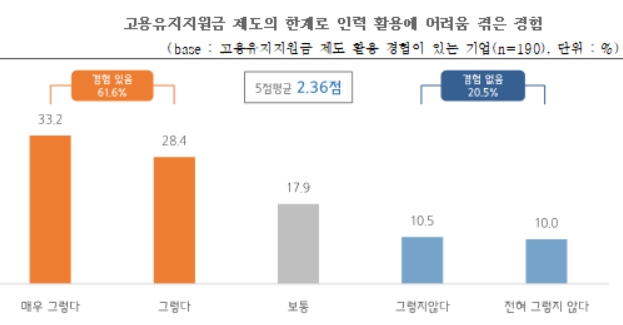 Experience of difficulties in workforce utilization due to limitations of the Employment Retention Support Fund system. Photo by Korea Federation of SMEs
As an alternative to the Employment Retention Subsidy system, 63.7% responded that the introduction of a "Korean-style PPP (Paycheck Protection Program)" system, which provides wage support without requiring temporary closure or leave as long as employment is maintained, is necessary. The Korean-style PPP system offers loan support for wages so that SMEs can utilize key personnel without temporary closure or leave, and reduces the loan amount if employment is maintained for a certain period.
The most needed improvement for the Employment Retention Subsidy system was "extension of the support period" (28.4%). Especially in special employment support industries that have been relatively more affected by COVID-19, 85.7% expressed the opinion that "extension of the support period is necessary."
Regarding the government's plan to cut the Employment Retention Subsidy budget by half next year, 78.4% responded negatively. This shows that the demand for the Employment Retention Subsidy system remains high in the field.
Lee Taehee, head of the Smart Job Division at the Korea Federation of SMEs, said, "Most SMEs using the Employment Retention Subsidy are striving to maintain employment for their workers despite severe management difficulties." He added, "Excessive regulations and penalties on workforce utilization not only make overcoming the prolonged crisis more difficult but also cause companies to avoid using the Employment Retention Subsidy system, which could negatively affect employment retention."
© The Asia Business Daily(www.asiae.co.kr). All rights reserved.

![A Woman with 50 Million Won Debt Clutches a Stolen Dior Bag and Jumps... A Monster Is Born [Slate]](https://cwcontent.asiae.co.kr/asiaresize/183/2026021902243444107_1771435474.jpg)
















