[Asia Economy Reporter Park Sun-mi] As domestic banks in Korea continue to close branches and consider ways to optimize branch operations, global banks have already adopted collaboration-based shared branch operations as an alternative.
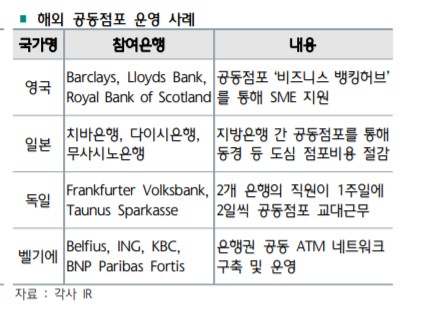
According to Hana Financial Management Research Institute on the 26th, Research Fellow Kwon Yong-seok recently stated in the report "Shared Branches Emerging as an Alternative to Bank Branch Closures" that "In the UK, following the 'Business Banking Hub' for small and medium-sized enterprises and SOHO in 2019, from April 2021, a 'Bank Hub' for general customers has been piloted in two regions. Each hub’s five banks provide face-to-face services on a rotating basis one day per week, and simple transactions such as deposits and withdrawals can also be handled at post offices where the hubs are located."
Research Fellow Kwon explained, "In Japan, regional banks such as Chiba Bank operate branches jointly through agreements with Daishi Bank, Musashino Bank, and others to expand coverage and maintain a community base. Regional banks maintain financial accessibility within local communities through interbank partnerships, while in urban areas like Minato Ward in Tokyo, shared branches help reduce rental costs."
Shared branches have the advantage of maintaining and protecting existing customers who are digitally marginalized at low cost. Since they operate targeting the existing customer base while maintaining the bank’s management independence and unique brand, they differ from corporate management integration such as mergers and acquisitions. Additionally, by jointly managing back-office tasks and reducing rental fees, they operate offline channels at low cost, maintaining financial accessibility for digitally marginalized groups. However, Research Fellow Kwon noted, "There are concerns that unclear responsibility for branch management and competition through product comparison among tenant banks could worsen the business environment."
Domestic banks also need to consider shared branches as a cost-saving and financial consumer protection measure. In fact, recently Hana Bank and Korea Development Bank established a collaborative model to enhance consumer financial accessibility by sharing branches and ATMs through a business agreement.
Research Fellow Kwon advised, "With the expansion of non-face-to-face transactions, the launch of internet-only banks, and market entry by big tech companies, banks have been working to optimize branches, and the number of commercial bank branches has been steadily decreasing since 2013. Going forward, domestic banks need to consider shared branch operation plans that achieve both cost reduction and consumer convenience amid the trend of branch optimization."
© The Asia Business Daily(www.asiae.co.kr). All rights reserved.
![From Bar Hostess to Organ Seller to High Society... The Grotesque Con of a "Human Counterfeit" [Slate]](https://cwcontent.asiae.co.kr/asiaresize/183/2026021902243444107_1771435474.jpg)
















