80% Leave Korea Workers' Compensation & Welfare Service, 75% Leave Korea Expressway Corporation
Rep. Kim Sang-hoon: "A Highly Unfair Matter from the Public's Perspective"
[Asia Economy Reporter Kim Hye-min] It has been revealed that 3 out of 10 public institution employees who received apartments through relocation to innovation cities have sold their apartments and left the area.
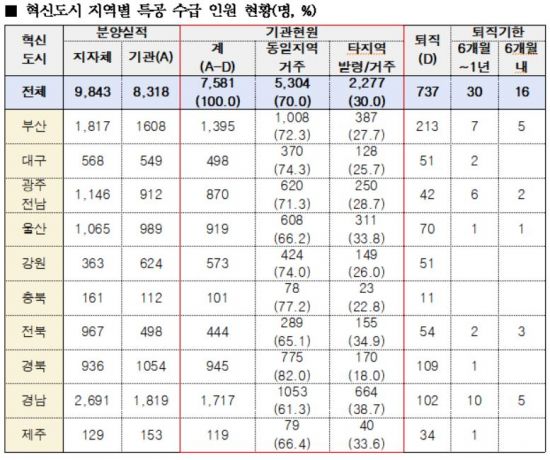
On the 26th, Kim Sang-hoon, a member of the National Assembly Land, Infrastructure and Transport Committee from the People Power Party, reported based on the 'Special Supply (Special Allocation) Recipient Residence and Transfer Status' data received from 115 public institutions relocated to innovation cities that, from 2010 to July of this year, 8,318 public institution employees who relocated to provincial areas received special supply apartments.
Among them, excluding 737 retirees, 2,277 out of 7,581 current employees either left the area to live elsewhere or were transferred to other regions. The government designated 11 innovation cities nationwide for balanced national development and provided special supply benefits for stable housing to public institution employees relocating there, but one in three ended up selling their homes and leaving.
The innovation city with the highest out-migration rate was Jinju, Gyeongnam. Among 11 institutions with 1,717 special supply recipients currently employed, 38.7% (664 people) left Gyeongnam or Jinju. This was followed by Jeonju, Jeonbuk (34.9%) and Ulsan (33.8%).
By institution, among 114 employees of the Korea Workers' Compensation and Welfare Service who relocated to Ulsan, 80.6% (116 people) received apartments through special supply and moved to the area. In the case of Korea Expressway Corporation relocated to Gimcheon, Gyeongbuk, 75.2% (76 out of 101 beneficiaries) left the area. The Korea Rural Community Corporation relocated to Gwangju Jeonnam, the Small and Medium Business Promotion Corporation relocated to Gyeongnam, and the Korea Land and Housing Corporation also had out-migration rates of 54.5%, 49.4%, and 47.3%, respectively.
There were also 16 employees who changed jobs within six months after receiving apartments through special supply. For example, Mr. A, who worked at Korea Electric Power Corporation, moved into an apartment through special supply on April 25, 2014, but resigned just six days later on May 1. Mr. B from the Korea Maritime Institute also changed jobs or resigned 10 days after receiving special supply on July 20, 2012.
Meanwhile, it was found that 13 out of the 115 institutions did not even have relevant data. These include the National Health Insurance Service, Rural Development Administration, National Institute of Meteorological Sciences, and National Fisheries Products Quality Management Service.
Assemblyman Kim stated, "The special supply benefits for stable housing for employees during the early stages of public institution relocation were somewhat unavoidable," but added, "In the current situation where it is difficult to own a home, leaving the house and area may be perceived as quite unfair from the public’s perspective." He emphasized, "For public institutions to be relocated in the future, alternative housing policies should be explored."
© The Asia Business Daily(www.asiae.co.kr). All rights reserved.

















