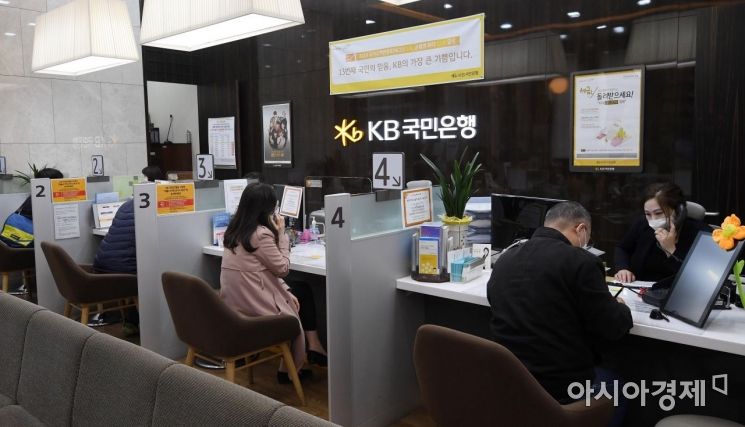
[Asia Economy Reporter Park Sun-mi] As the growth rate of household loans in the banking sector approaches the financial authorities' target of 5-6% annually, the likelihood of a series of loan restriction measures across banks continuing until the end of the year has increased.
According to the financial sector on the 25th, KB Kookmin Bank, which saw its household loan growth rate exceed 4% this month, will start from the 29th to restrict or significantly reduce the limits on credit loans, mortgage loans, jeonse (key money deposit) loans, and group loans as additional loan restrictions. A KB Kookmin Bank official stated, "The loan limits are being temporarily reduced to properly manage household loans," explaining that "the increase in loan growth was influenced by loan regulations at some other banks."
First, refinancing loans from other banks to KB Kookmin Bank loans with lower interest rates will be prohibited across credit loans, jeonse loans, and mortgage loans.
Also, the limit on jeonse loans will be reduced to "within the range of the increased deposit (jeonse price)." Previously, loans up to 80% of the deposit were possible, but from the 29th, the maximum limit will be restricted to the amount of the deposit increase. For group loans, the collateral criteria for move-in balance loans will change from the existing KB market price or appraisal value to the lowest amount among the sale price, KB market price, and appraisal value. Since the sale price is likely to be the main standard, the loan limit for balance payments is expected to decrease significantly.
In mortgage loans, subscription to Mortgage Credit Insurance (MCI) and Mortgage Credit Guarantee (MCG) will also be restricted. MCI and MCG are insurances subscribed simultaneously with mortgage loans; borrowers with this insurance can borrow up to the Loan-to-Value (LTV) ratio, but without insurance, loans are only possible for the amount excluding small rental deposits.
Earlier, KB Kookmin Bank reduced preferential interest rates on mortgage and jeonse loans by 0.15 percentage points each from the 16th and adjusted the Debt Service Ratio (DSR) application rate for non-regulated areas not subject to the 40% DSR regulation from 100-120% to 70%. The DSR ratio for living stabilization funds within jeonse loans was also adjusted from within 100% to within 70% as part of tightening loan measures.
High Possibility of 'Additional' Household Loan Tightening Spreading Across Banking Sector
Although there are more than three months left until the end of this year, the household loan growth rates of the five major commercial banks are already close to the authorities' target of 5-6%, increasing the likelihood that additional loan tightening will spread across the banking sector. This year, the authorities ordered commercial banks to strengthen total loan volume management to maintain household loan growth rates at 5-6%, but a balloon effect has formed where reducing loans in one area leads to increases in another.
Previously, NH Nonghyup Bank completely stopped new mortgage loans after its household loan growth rate exceeded 7%. Also, Woori Bank limited personal credit loan amounts to within annual income from the 15th. This limit was applied to eight products including 'Woori Workplace Loan' and 'Woori Main Transaction Workplace Loan.' Relatively low-interest mortgage and jeonse loan products based on the new balance COFIX have also been temporarily suspended.
Shinhan Bank raised the additional interest rate on jeonse loans by 0.2 percentage points earlier this month and has been applying a maximum credit loan limit of 100% of annual income since the 10th.
Although Woori Bank and Shinhan Bank's household loan growth rates are still below 4%, at 3.9% and 2.8% respectively, if the balloon effect occurs due to KB Kookmin Bank's additional loan tightening, loan growth could accelerate sharply, making further measures inevitable by the end of the year.
Meanwhile, the financial authorities plan to announce additional household debt management measures early next month.
As part of the additional household debt management measures, it is known that they are considering advancing the schedule for phased implementation of borrower-specific Debt Service Ratio (DSR) regulations and strengthening DSR regulations on the secondary financial sector. On the 10th, Financial Services Commission Chairman Ko Seung-beom told reporters, "After Chuseok, we are meticulously analyzing 20 to 30 detailed items at the working level to prepare additional supplementary measures."
© The Asia Business Daily(www.asiae.co.kr). All rights reserved.

















