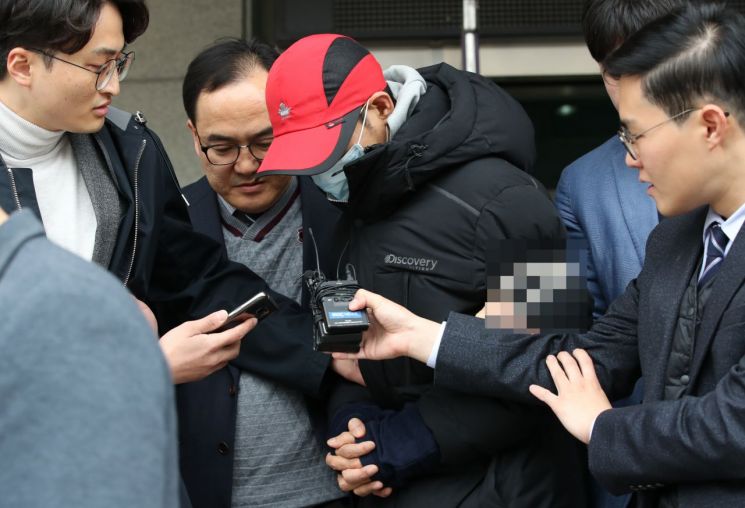
 Cryptocurrency issuer Coinup was effectively operated by CEO Seokjeong Kang, known as 'Cash Kang'
 [Image source=Yonhap News]
On the 25th, according to the legal community, Judge Hong Changwoo of the Seoul Central District Court Criminal Division 1 recently sentenced A (53, female), who was indicted for harboring a criminal, to a fine of 5 million won.
Earlier, A was put on trial for hiding B, her common-law husband and the nominal CEO of the cryptocurrency issuing company Coinup, for about 1 year and 4 months starting from February 2019.
At that time, B’s younger brother and Coinup’s de facto operator, CEO Kang Seokjeong of 'Cashgang,' was under arrest and investigation on charges including fraud under the Specific Economic Crimes Act for deceiving investors by promising profits through listing 'Solpa Coin' purchased via Coinup, collecting investment funds amounting to 450 billion won.
Regarding this case, A is accused of helping B, who had a warrant issued for his arrest and was wanted, to evade capture by moving around lodging facilities in the metropolitan area. B died in May last year while on the run, and subsequently, CEO Kang was sentenced to 16 years in prison by the Supreme Court.
Article 151, Paragraph 1 of the current Criminal Act stipulates that "If a person harbors or helps a person who has committed a crime punishable by a fine or higher, they shall be punished by imprisonment for up to three years or a fine of up to 5 million won."
The court found A guilty and sentenced her to a fine. Article 151, Paragraph 2 of the Criminal Act states that "If a relative or cohabiting family member commits the crime of harboring for the person, they shall not be punished," but A did not qualify for this exemption as she was a common-law spouse who had not registered her marriage with B.
Meanwhile, C (50), who was indicted on charges including fraud and harboring a criminal for impersonating a prosecutor’s investigator and extorting hundreds of millions of won from A and B by claiming to help them escape, was sentenced to 4 years in prison and a fine of 331 million won in the first trial in March. C forged a level 6 investigator’s ID from the Supreme Prosecutors’ Office and deceived B and others by saying, "To be tried without detention, you must pay money to the Supreme Prosecutors’ Office section chief," and had them sign contracts for houses under false names or rent hotel rooms, embezzling money in return.
© The Asia Business Daily(www.asiae.co.kr). All rights reserved.
![Clutching a Stolen Dior Bag, Saying "I Hate Being Poor but Real"... The Grotesque Con of a "Human Knockoff" [Slate]](https://cwcontent.asiae.co.kr/asiaresize/183/2026021902243444107_1771435474.jpg)
















