First In-Person Summit of US, Japan, India, and Australia in Washington
Emphasizing Mutual Cooperation Without Mentioning China
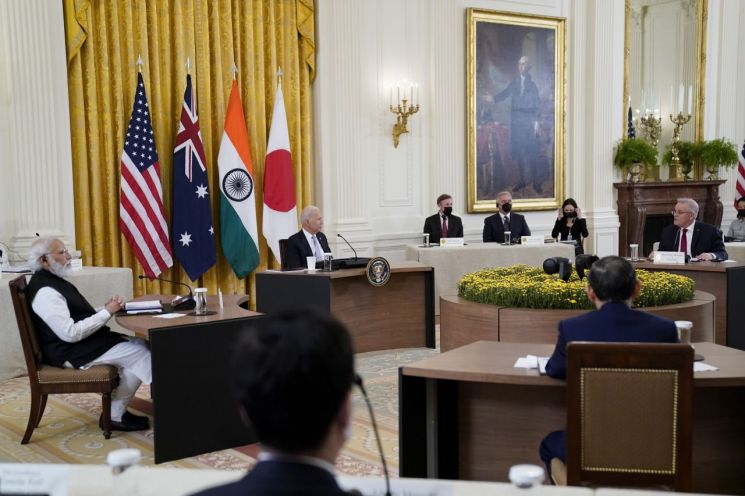
[Asia Economy New York=Correspondent Baek Jong-min] The Quad summit, attended by the leaders of the United States, Japan, India, and Australia, was held at the White House on the 24th (local time). Amid China's backlash, the participating countries focused on reaffirming mutual solidarity rather than making direct references targeting China.
U.S. President Joe Biden, Japanese Prime Minister Yoshihide Suga, Australian Prime Minister Scott Morrison, and Indian Prime Minister Narendra Modi held their first in-person Quad summit following a virtual meeting in March.
The four leaders gathered in Washington on the occasion of the United Nations General Assembly. Prime Minister Suga, whose retirement is imminent, also attended, showcasing the close ties among the Quad countries.
The leaders unanimously emphasized the importance of a "free and open Indo-Pacific" and stressed solidarity.
President Biden said, "When we met six months ago, we made concrete commitments to advance a positive joint agenda for a free and open Indo-Pacific," adding, "Today, I am proud to say that great progress is being made."
President Biden cited cooperation examples among Quad countries, including support for COVID-19 vaccines to developing countries, climate change response, and the launch of the "Quad Fellowship" program, which selects scholars from each country to pursue master's and doctoral degrees in science and technology.
Prime Minister Modi pledged cooperation, stating that the vaccine support initiative would greatly benefit Indo-Pacific countries and evaluated that Quad cooperation would ensure prosperity and peace in the Indo-Pacific.
Prime Minister Morrison said there is no region more dynamic than the Indo-Pacific globally and that many challenges must be overcome, presenting cooperation agendas such as pandemic response, climate change, technology, cyberspace, and supply chains.
He also emphasized that the Indo-Pacific should be a place free from coercion, where sovereignty is respected, and disputes are peacefully resolved in accordance with international law.
Prime Minister Suga said the summit demonstrated the strong solidarity of the four countries and a firm commitment to the shared vision of a free and open Indo-Pacific.
The United States maintains that the Quad is not aimed at China, but China has openly expressed strong opposition.
Zhao Lijian, spokesperson for the Chinese Ministry of Foreign Affairs, strongly condemned the summit, saying, "Closed and exclusive moves targeting other countries will not gain support and are doomed to fail."
Seemingly aware of China's backlash, White House spokesperson Jen Psaki dismissed the notion at a regular briefing, stating, "The Quad is not a security meeting or a security organization." Other senior officials also emphasized that the Quad and AUKUS are meant to enhance cooperation among allies.
A major foreign media outlet assessed that despite Quad member countries conducting joint naval exercises to counter China's expanding influence, they tried not to highlight security aspects at this meeting.
Meanwhile, on the same day, the United States opened a path to return Meng Wanzhou, Huawei's vice-chairwoman, to China, a factor considered a point of conflict in U.S.-China relations.
The U.S. claimed that Meng was involved in fraud related to transactions with Iran, and the Canadian government has kept Meng under house arrest for three years.
© The Asia Business Daily(www.asiae.co.kr). All rights reserved.

















