2924 Confirmed Cases by 9 PM on the 24th
First Daily New Cases Expected to Reach 3000s
"Early Next Week, Cases May Increase Beyond That"
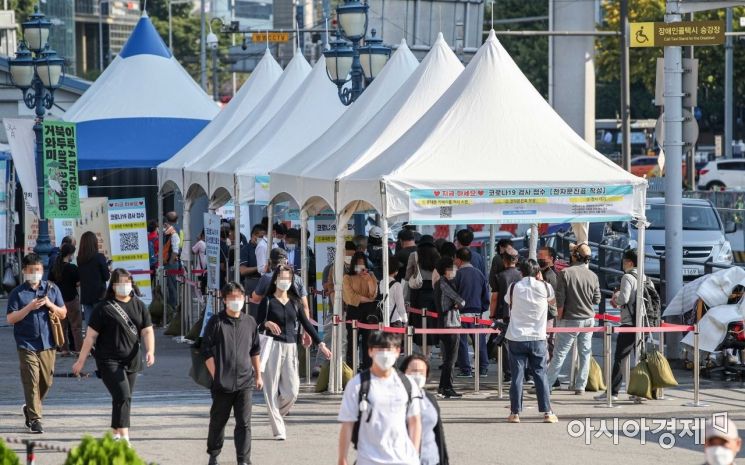 On the 24th, when 2,434 new COVID-19 cases were confirmed, marking the highest number since the outbreak, citizens visiting the temporary screening clinic set up at Seoul Station Plaza are waiting to get tested. Photo by Kang Jin-hyung aymsdream@
[Asia Economy Reporter Kim Ji-hee] The number of COVID-19 confirmed cases is surging. Following a rise to the 2,400 range on the 24th, right after the Chuseok holiday, the 25th is expected to mark the first time daily confirmed cases reach the 3,000 range.
According to the quarantine authorities and local governments on the 25th, 2,924 people tested positive for COVID-19 from midnight to 9 p.m. the previous day. Since the daily new confirmed cases are tallied and announced at midnight, the number of patients reported as of 0:00 on the 25th is expected to be at least in the 3,000 range, possibly reaching 3,200 to 3,300.
This is the first time since the first COVID-19 case was confirmed domestically that daily confirmed cases have exceeded 3,000. The previous highest record was 2,434 cases announced as of midnight the day before. The number of confirmed cases in 21 hours already exceeds the previous daily record by about 500.
By 9 p.m., 76.1% of the new confirmed cases were concentrated in the Seoul metropolitan area. In Seoul, for the first time since the COVID-19 outbreak, confirmed cases surpassed 1,000 by 9 p.m. Gyeonggi and Incheon recorded 806 and 195 cases respectively, totaling 2,224 confirmed cases in the metropolitan area alone. In non-metropolitan areas, an additional 700 cases were reported: Daegu 116, Chungnam 84, Daejeon 80, Chungbuk 60, Gyeongbuk 58, Gangwon 55, Jeonbuk 53, Busan 46, Gyeongnam 42, Gwangju 40, Jeonnam 27, Ulsan 24, Jeju 15. Confirmed cases were reported in 16 cities and provinces excluding Sejong.
The quarantine authorities also expect the number of confirmed cases to increase further following the Chuseok holiday. However, the future scale of the outbreak remains uncertain. Park Young-jun, head of the epidemiological investigation team at the Central Disease Control Headquarters, said at a briefing the day before, "Considering the trend of increased movement before Chuseok, we expect confirmed cases to continue rising into early next week or beyond," adding, "Because there are many factors that can cause the number of confirmed cases to either decrease or increase, it is difficult to predict the exact scale at this time."
The situation in the metropolitan area is particularly serious. The incidence rate of confirmed cases per 100,000 people in the metropolitan area is 5.4. Especially in Seoul, it is 7.2, significantly higher than Gyeonggi and Incheon, which are in the 4 range. Non-metropolitan areas remain relatively stable with about 2 cases per 100,000 people, but it is still difficult to be complacent. The spread centered in the metropolitan area may have extended to non-metropolitan areas during the Chuseok holiday.
Lee Ki-il, the first controller of the Central Disaster and Safety Countermeasures Headquarters, expressed concern, saying, "With the severe spread of the outbreak in the metropolitan area continuing before the holiday, the nationwide increase in movement during the Chuseok holiday is likely to cause an increase in confirmed cases in non-metropolitan areas as well."
© The Asia Business Daily(www.asiae.co.kr). All rights reserved.

















