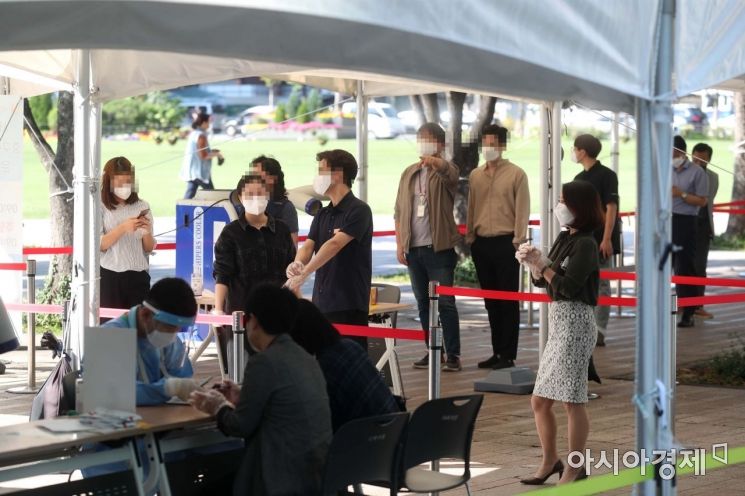
 On the 24th, after the Chuseok holiday ended and COVID-19 cases surged, the temporary screening clinic in front of Seoul City Hall was crowded with citizens. The Central Disease Control Headquarters of the Korea Disease Control and Prevention Agency announced that 2,434 new COVID-19 cases were confirmed as of midnight that day. Photo by Moon Honam munonam@
[Asia Economy Reporter Lee Chun-hee] On the 24th, as the daily new COVID-19 cases reached a record high of 2,434, health authorities predicted that the number of COVID-19 cases could continue to rise next week.
Park Young-jun, head of the epidemiological investigation team at the Central Disease Control Headquarters, said at the COVID-19 briefing that afternoon, "Considering the increasing trend in mobility observed since before Chuseok, we expect that the number of confirmed cases could increase early next week or even beyond that." However, he added, "Because various factors can cause the number of confirmed cases to either decrease or increase, it is difficult to predict the exact scale of cases at this time."
In particular, among the 2,434 new confirmed cases reported that day, 59.3% were in the 20-40 age group, raising concerns as the spread continues mainly among younger people who have high levels of social activity. Breaking down the 2,434 cases by age group: ▲20s: 549 cases (22.6%) ▲40s: 449 cases (18.5%) ▲30s: 445 cases (18.3%) ▲50s: 322 cases (13.2%) ▲teens: 222 cases (9.1%) ▲60s: 212 cases (8.7%) ▲0-9 years: 119 cases (4.9%) ▲70s: 81 cases (3.3%) ▲80 and above: 35 cases (1.4%). The 20-40 age group accounts for a total of 1,443 cases, representing more than half of the total.
Regarding this, Team Leader Park said, "This is the general pattern since July." Since the 20-40 age group has a relatively low vaccination rate and high social activity, there are more opportunities for infection. "Linked to this, because the chances of infection are high and immunity levels are relatively low, the scale of cases is currently large," he explained.
In fact, as of midnight that day, the COVID-19 vaccination completion rate shows that among 13,153,568 elderly people aged 60 and above, 11,403,060 (86.7%) have completed vaccination, and nearly half (48.1%) of those in their 50s have also completed vaccination. In contrast, only 7,045,362 people (31.4%) out of 22,415,616 young adults aged 18-49 have received all recommended doses.
© The Asia Business Daily(www.asiae.co.kr). All rights reserved.

















