Days with a Diurnal Temperature Range Above 10℃ Decreased from 56.2 to 49.0 Days
Autumn Diurnal Temperature Range Down 0.9℃ Compared to the 1990s... Due to Rising Minimum Temperatures
[Asia Economy Reporter Han Jinju] The number of days with a temperature difference of more than 10 degrees Celsius during autumn has decreased by 7.2 days over the past 10 years.
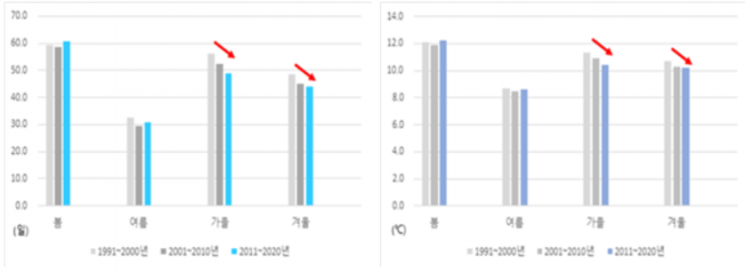
On the 24th, the Korea Meteorological Administration announced that the average number of days with a temperature difference of more than 10 degrees Celsius over 30 years (1991?2020) is 52.5 days, and compared to the 1990s (56.2 days), the number of days in the recent 10 years (49.0 days) has decreased by 7.2 days.
The average temperature difference during autumn is 10.9 degrees Celsius, which is 0.9 degrees lower than the 1990s (11.3 degrees) over the past 10 years (10.4 degrees). The decrease in autumn temperature difference is due to the minimum temperature in autumn rising by 0.9 degrees Celsius over the past 10 years.
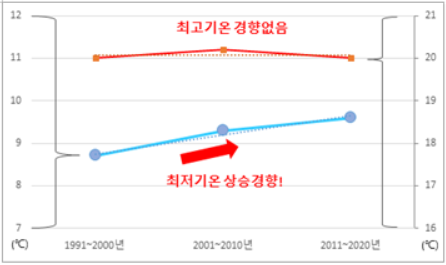
When comparing by periods, autumn and winter have shown a significant decrease compared to the 1990s. The maximum temperature remains around 20 degrees Celsius, showing little change from about 20 years ago, but the minimum temperature has risen, reducing the temperature difference.
The number of days with a temperature difference of more than 10 degrees Celsius in autumn is higher in inland areas and lower along the coast. Uiseong, Jecheon, Geumsan, and Bonghwa had more than 70 days, while Yeosu, Incheon, Busan, and Jeju had fewer than 20 days. In Seoul, the number of days with a temperature difference over 10 degrees Celsius is 33 days, and the temperature difference is 8.8 degrees Celsius.
The Korea Meteorological Administration explained, "Although the temperature difference is decreasing, the risk of exposure to circulatory and respiratory diseases increases during the transition from summer to autumn, so health management should be prepared."
The Korea Meteorological Administration provides the Asthma and Pulmonary Disease Possibility Index and Stroke Possibility Index year-round using temperature differences, and offers the Cold Possibility Index from September to April of the following year.
© The Asia Business Daily(www.asiae.co.kr). All rights reserved.
![User Who Sold Erroneously Deposited Bitcoins to Repay Debt and Fund Entertainment... What Did the Supreme Court Decide in 2021? [Legal Issue Check]](https://cwcontent.asiae.co.kr/asiaresize/183/2026020910431234020_1770601391.png)
















