Mun: "End-of-war declaration... an important starting point for creating an order of reconciliation and cooperation on the Korean Peninsula"
Expert: "We know the 2030 'end-of-war declaration' lacks effectiveness"
"North Korea repeatedly changes its stance, lowering trust"
Government: "An opportunity to set aside hostile intentions without immediate large costs... will be the gateway to peace on the Korean Peninsula"
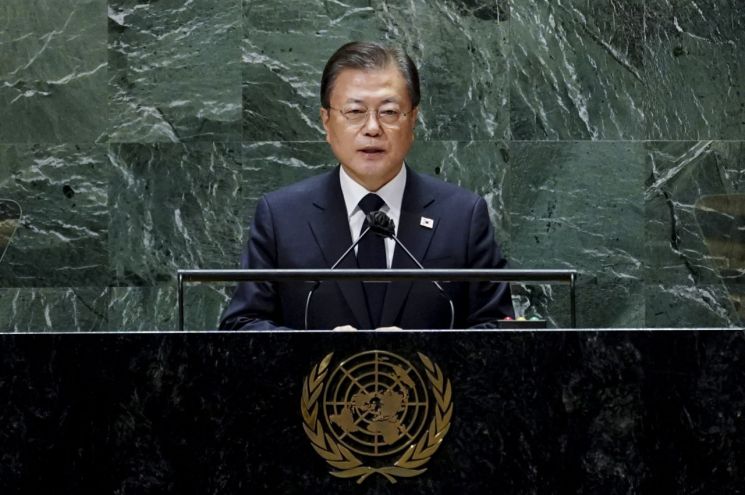 President Moon Jae-in proposed a declaration of the end of the war during his keynote speech at the United Nations General Assembly in New York on the 21st (local time).
 [Image source=Yonhap News]
[Asia Economy Reporter Yoon Seul-gi] President Moon Jae-in proposed the fourth declaration of the end of the war in his keynote speech at the United Nations General Assembly. North Korea left the door open for dialogue, saying it could engage in constructive discussions. Expectations are growing that the frozen inter-Korean relations, following North Korea's recent ballistic missile launches, might restart negotiations and dialogue based on this opportunity.
However, among the MZ generation, including those in their 20s and 30s, opinions suggest that while the declaration of the end of the war is good, more focus should be placed on revitalizing the domestic economy immediately. They feel that government policies toward North Korea, such as unification and the declaration of the end of the war, do not strongly resonate with their daily lives. The government emphasized that the declaration of the end of the war is the most optimal measure for North and South Korea to lay down hostility toward each other and move toward peace.
President Moon proposed the declaration of the end of the war during his keynote speech at the 76th United Nations General Assembly held in New York on the 21st (local time). This is the fourth time after 2018, 2019, and 2020.
President Moon appealed to the international community, saying, "The declaration of the end of the war will be an important starting point to create a new order of reconciliation and cooperation on the Korean Peninsula," and "When the parties involved in the Korean War come together to achieve the declaration of the end of the war, irreversible progress in denuclearization and complete peace can begin." He added, "The beginning of peace on the Korean Peninsula is always dialogue and cooperation. I urge the prompt resumption of dialogue between North and South Korea and between North Korea and the United States," emphasizing, "I hope that dialogue and cooperation will prove to create peace on the Korean Peninsula."
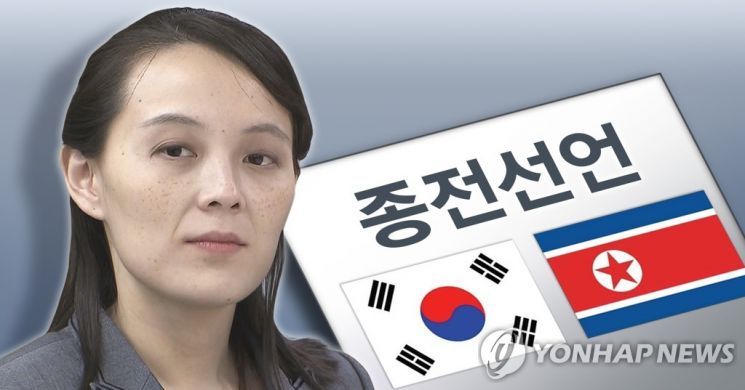 On the afternoon of the 25th, Kim Yo-jong, Vice Director of the Workers' Party of Korea, gave a positive response to President Moon Jae-in's proposal for a 'Declaration of the End of the War.'
 [Image source=Yonhap News]
North Korea also issued an official statement. Earlier on the morning of the 24th, Ri Tae-sung, Vice Minister of Foreign Affairs of North Korea, emphasized in a statement to the Korean Central News Agency that it was "premature" and that the U.S. must withdraw its hostile policy.
However, Kim Yo-jong, Deputy Director of the North Korean Workers' Party, expressed a positive stance on the declaration of the end of the war in a statement released through the Korean Central News Agency on the same afternoon, saying, "The declaration of the end of the war is not bad," and "The declaration of the end of the war, which physically ends the long-standing unstable armistice state on the Korean Peninsula and withdraws hostility toward the other party, is an interesting proposal and a good idea."
Kim Yo-jong added a conditional clause, "If the South Korean side is not hostile," but expressed a positive position on the declaration of the end of the war, saying, "We are willing to engage in constructive discussions on the prospects for restoring and developing relations."
However, the MZ generation (a term encompassing the Millennial generation born from the early 1980s to the early 2000s and the Z generation born from the mid-1990s to the early 2000s) showed lukewarm reactions.
A 20-something office worker, Mr. A, said, "President Moon seems to not understand the feelings of people in their 20s," adding, "It is true that the declaration of the end of the war should be done, but now is not the right time. The economy and reality are tough. Korea's aspirations are not only about the declaration of the end of the war, but it seems the focus is only on that," expressing regret.
A 20-something job seeker, Mr. B, showed a similar reaction. Mr. B said, "Since we are not from the war generation, we do not have a strong perception that Korea is in an armistice state," adding, "Although there have been several crises, the atmosphere has generally been peaceful. So talking about the declaration of the end of the war does not resonate much, and I do not feel the necessity."
Another 20-something university student, Mr. C, said, "It feels like political rhetoric. With the term almost over, I doubt its feasibility," adding, "President Moon said to declare the end of the war and then pursue denuclearization, but I think denuclearization should be firmly achieved first before declaring the end of the war. It seems like something said ahead of the presidential election, and since nothing changed even after meeting Kim Jong-un in 2018, I have no expectations."
Meanwhile, there are opinions that there is no longer any expectation due to the repeated declarations of the end of the war over several years. A 20-something university student, Mr. D, said, "Recently, inter-Korean relations have been heightened, and it seems President Moon declared the end of the war to ease tensions," adding, "A few years ago, when the U.S. and North Korea held summits, all attention was focused, but it ended in failure because the calculations did not match. Since the declaration of the end of the war is repeated annually without results, I do not think doing this will improve inter-Korean relations."
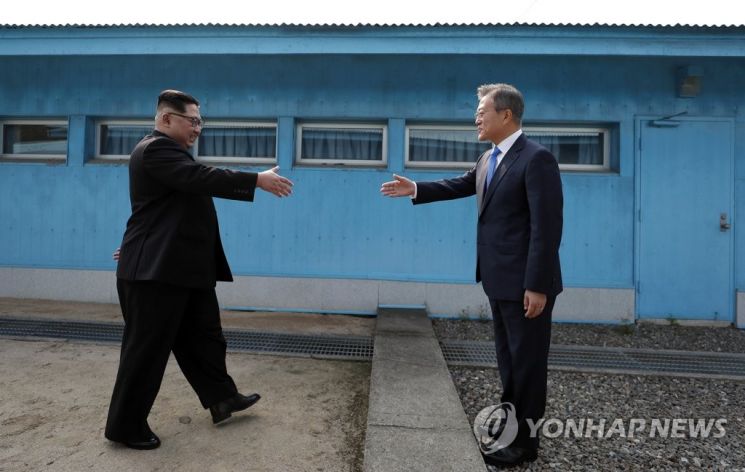 President Moon Jae-in and Kim Jong-un, General Secretary of North Korea, are shaking hands across the Military Demarcation Line at Panmunjom on April 27, 2018.
 [Image source=Yonhap News]
Experts analyzed that the MZ generation's lack of strong reaction to the declaration of the end of the war is because "even if inter-Korean relations seem to be progressing, they realize it is ultimately ineffective."
Political commentator Lee Jong-hoon said, "Although President Moon and North Korea have exchanged several rounds of engagement, there has been no progress in inter-Korean relations," adding, "The MZ generation is a post-ideological generation that moves based on practical benefits. Unlike previous generations who spoke of unification aspirations, they do not have a sense of urgency to push for unification. With the repeated cycles of reconciliation atmosphere and deadlock, interest in inter-Korean relations has declined." He continued, "In the failed North Korea-U.S. summit, North Korea talked about denuclearization but ultimately maintained its nuclear possession stance. Even if North Korea responds positively to the declaration of the end of the war, the MZ generation does not have high expectations due to the lack of trust."
Meanwhile, the government emphasized that the proposal of the declaration of the end of the war itself can create a peaceful atmosphere. On the afternoon of the 24th, Lee In-young, Minister of Unification, attended a commemorative seminar held at the COEX conference room hosted by the Korea Unification and Foreign Affairs Association, stating, "The declaration of the end of the war is the gateway to peace on the Korean Peninsula and a catalyst for denuclearization negotiations," adding, "It does not require significant costs immediately, and in the military field, it is a very useful and important measure that can promote mutual trust and respect by laying down war and hostile intentions without sudden changes in the situation."
© The Asia Business Daily(www.asiae.co.kr). All rights reserved.
!["The Woman Who Threw Herself into the Water Clutching a Stolen Dior Bag"...A Grotesque Success Story That Shakes the Korean Psyche [Slate]](https://cwcontent.asiae.co.kr/asiaresize/183/2026021902243444107_1771435474.jpg)


















