On the 27th, KDCA and Ministry of Education Announce Vaccination Plan
Higher Side Effect Rate in Younger Ages and After Second Dose
Post-Chuseok Surge in Cases... Concerns Over Rising Student Infections
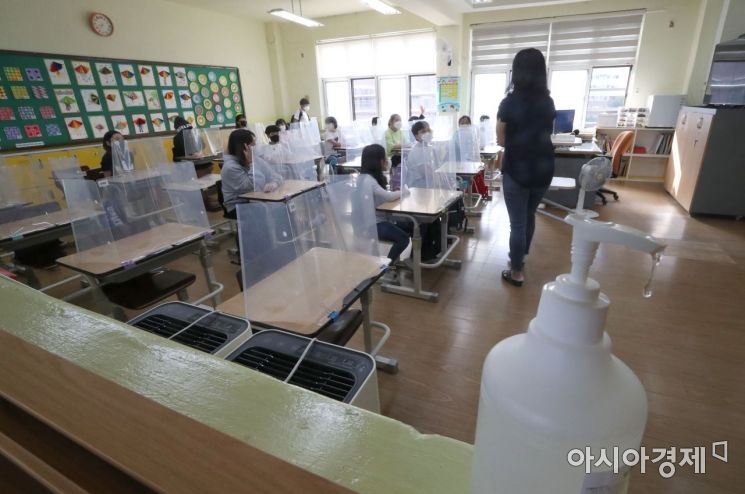 On the morning of the 6th, when most schools nationwide had started the new semester, hand sanitizer was placed in a 4th-grade classroom at Beondong Elementary School in Gangbuk-gu, Seoul.
[Asia Economy Reporter Han Jinju] Expectations and concerns are mixed ahead of the announcement of the vaccination plan for children and adolescents aged 12 to 17.
The Ministry of Education and quarantine authorities have a basic policy to allow children and adolescents to be vaccinated only if they wish, just like high school seniors (grade 12). However, due to vaccine side effects such as myocarditis, there is a growing concern among parents about vaccination.
Based on research results showing that the younger the age, the higher the rate of side effects after the second dose, there is a possibility of proposing different vaccination criteria from adults. The UK has limited the number of vaccinations for children and adolescents to one dose. According to a study by Dr. Tracy Hogg's team at the University of California, the incidence rate of myocarditis among vaccinated individuals aged 12 to 15 was 162 per million, higher than that of 16 to 17-year-olds (94 per million).
Professor Cheon Eun-mi of the Department of Infectious Diseases at Ewha Womans University Mokdong Hospital said, "Since the frequency of myocarditis after the second dose is high and antibodies are produced with just the first dose providing preventive effects, it is advisable to recommend only the first dose."
With a rapid increase in confirmed cases immediately after the Chuseok holiday, full in-person schooling has become difficult in the short term. Currently, the metropolitan area is still under Level 4 social distancing, allowing only two-thirds attendance for elementary and middle schools, while high schools can have full attendance. The Ministry of Education states that full or expanded in-person schooling is possible only if supported by vaccination and other quarantine measures.
On the 24th, Yoo Eun-hye, Deputy Prime Minister and Minister of Education, will hold a meeting with superintendents of education offices nationwide to discuss support for detailed vaccination plans. They will listen to vaccination schedules, target groups, educational course operation plans related to vaccination, and precautions, and based on opinions raised at the meeting, will announce academic operation plans related to vaccination on the 27th.
Professor Cheon said, "Before the third wave, the government planned full in-person schooling, but with the Delta variant and the record high number of confirmed cases again, it is necessary to comprehensively assess the trends of confirmed and hospitalized patients and vaccination rates, and rather than full attendance, it is necessary to gradually increase the number of students attending school."
© The Asia Business Daily(www.asiae.co.kr). All rights reserved.

















