[Asia Economy Reporter Lee Ji-eun] North Korea responded with a statement calling South Korean President Moon Jae-in's proposal for a declaration of the end of the war "premature" just two days after it was made, dimming the prospects of bringing North Korea to the dialogue table. However, analysts suggest that North Korea did not solely emphasize the unnecessary nature of the declaration but rather hinted at its "somewhat meaningful" aspect, leaving room for dialogue. This is seen as a subtle form of "response," indicating that North Korea would engage in talks if substantive actions such as the lifting of U.S. sanctions are taken instead of merely declarative measures.
◆ North Korea says 'premature' but also 'meaningful' = Experts highlight that the notable part of the statement issued on the 24th under the name of Ri Tae-sung, Vice Minister of Foreign Affairs of North Korea, is not the phrase "the declaration of the end of the war is premature" but the supplementary explanation that "it has symbolic meaning as a political declaration."
Shin Beom-chul, head of the Center for Foreign Policy and Security at the Korea Institute for Industrial Economics and Trade, said in a phone interview that day, "It can be interpreted as meaning that if sanctions are eased and the South Korea-U.S. joint military exercises are suspended?things North Korea wants?then they could come to the dialogue table."
Kim Yong-hyun, professor of North Korean Studies at Dongguk University, also said, "This statement is not a rejection of the declaration of the end of the war but rather a way of passing the ball to the U.S. and South Korea to remove obstacles in advance," adding, "It does not necessarily have to be viewed negatively." In the statement, Vice Minister Ri said, "The overall facts prove that it is not yet time to declare the end of the war. The current reality raises the issue that adopting a declaration of the end of the war is premature."
However, the statement begins by acknowledging that "there is symbolic meaning as a political declaration that publicly ends the armistice state on the Korean Peninsula." Vice Minister Ri also said, "It is clear that declaring the end of the war is an issue that must be addressed at least once on the path toward establishing a peace guarantee system." This indicates that North Korea is not completely closing off the possibility of dialogue by recognizing the necessity of the declaration.
◆ Deciding to provide 10 billion won for North Korea support projects = Ultimately, by not immediately responding to President Moon's proposal for a declaration of the end of the war and passing the ball back to South Korea and the U.S., a considerable period of tense standoff or stalemate seems inevitable before any breakthrough in inter-Korean or North Korea-U.S. relations can occur. Yang Moo-jin, professor at the University of North Korean Studies, said, "It means that the Biden administration should not use North Korea talks as an event like the Trump administration did but should actively work on creating an environment and conditions."
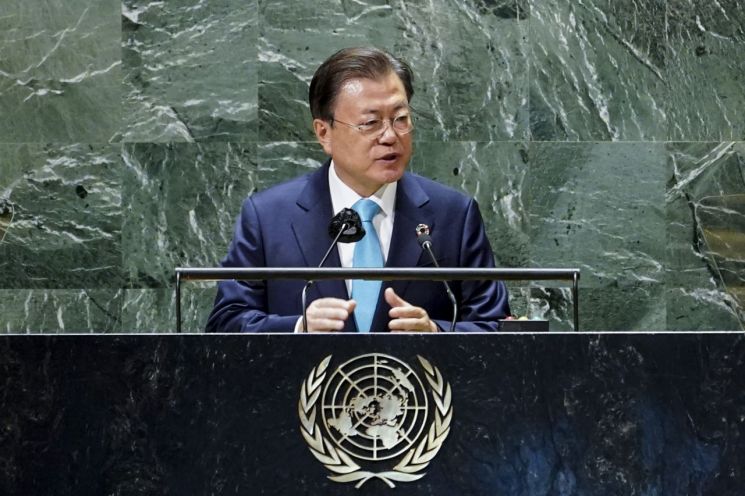
Accordingly, attention is turning to what additional measures or remarks President Moon, who proposed the declaration, will make following North Korea's response. On the 21st (local time), President Moon proposed the declaration in his keynote speech at the United Nations General Assembly in New York, and on the 22nd, during an in-flight press conference on his return, he reiterated his commitment by saying, "(The declaration of the end of the war) was agreed upon in the October 4, 2007 Joint Declaration."
Despite North Korea's rejection, the South Korean government has not wavered in its willingness to provide support. On the morning of the same day, the government held the 322nd South-North Exchange and Cooperation Promotion Council meeting and decided to provide 10 billion won to civilian organizations carrying out nutrition and health cooperation projects in North Korea. Minister of Unification Lee In-young explained, "Due to the prolonged blockade caused by COVID-19, shortages of food and health supplies inside North Korea are becoming increasingly severe."
Meanwhile, in the statement released through the Korean Central News Agency on the same day, Vice Minister Ri criticized, "The U.S. military forces deployed or mobilized on land, sea, air, and underwater around the Korean Peninsula, along with vast modern war assets and various annual war exercises under different names, show that the U.S. hostile policy toward North Korea is becoming increasingly vicious day by day." He pointed out the "double standards of the U.S. that label our legitimate defense strengthening measures as 'provocations' while glorifying the military buildup of the U.S. and its followers who threaten us as 'securing deterrence.'"
He further expressed concern, saying, "We must clearly see that a declaration of the end of the war at this point in time does not help stabilize the situation on the Korean Peninsula at all and could be misused as a smokescreen to conceal the U.S. hostile policy."
© The Asia Business Daily(www.asiae.co.kr). All rights reserved.

















