About One Year of Pilot Operation... No Further Expansion
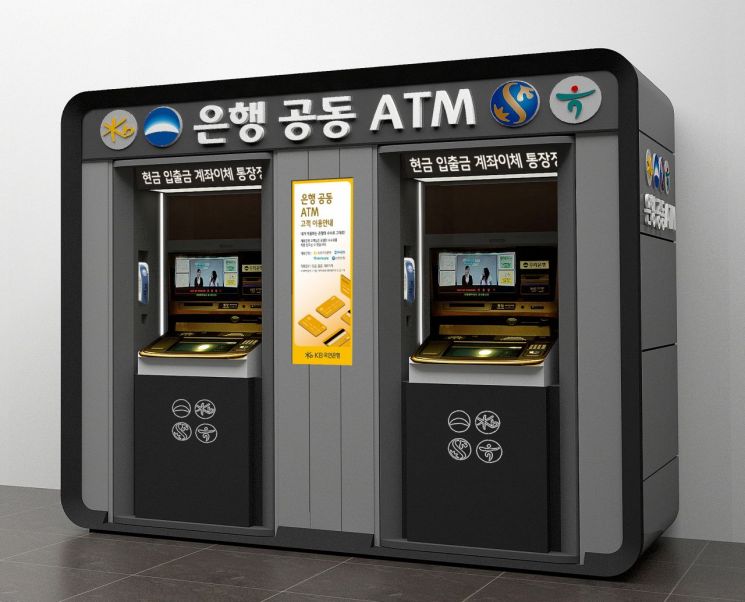
[Asia Economy Reporter Park Sun-mi] Last year, the expansion of joint cash automated teller machines (ATMs) piloted by the four major commercial banks?KB Kookmin, Shinhan, Hana, and Woori?has come to a standstill. Amid a rapid decline in the number of bank branches and ATM installations due to the rise of non-face-to-face transactions and decreased cash usage, customer demand for joint ATMs has also significantly dropped. Commercial banks are considering enhancing operational efficiency by expanding financial convenience stores through partnerships with convenience stores that have high customer accessibility, as well as operating joint branches among banks, instead of expanding joint ATMs.
According to the financial sector on the 24th, since the pilot installation of joint ATMs at four Emart locations nationwide (Hanam, Namyangju Jinjeop, Dongtan, and Gwangju Gwangsan) in August last year, no additional installations have been made in just over a year. A major inconvenience of joint ATMs is the limitation of available services, including the inability to conduct passbook transactions (passbook updating, passbook withdrawals). From the customer's perspective, even if they do not use joint ATMs, they can withdraw cash from other banks' ATMs using their bank card as long as they are willing to pay the fees.
An official from a bank explained, "If the pilot phase had shown good results, there would have been a trend toward expanding joint ATM installations. However, large-scale system overhauls such as inter-bank IT integration are required for full-scale expansion, making it difficult." He added, "Most customers who do not perform passbook transactions use bank applications for non-face-to-face financial transactions, and the number of people using cash withdrawals?the main function of joint ATMs?is also decreasing."
As cash usage declines, the number of ATMs is rapidly decreasing nationwide.
According to the ‘ATM Installation Status by Metropolitan City and Province’ obtained by Yoon Kwan-seok, a member of the National Assembly’s Political Affairs Committee from the Democratic Party, through the Bank of Korea, 1,769 ATMs disappeared nationwide last year. In Seoul alone, 896 ATMs disappeared, followed by Busan with 417, Gyeonggi with 179, Incheon with 176, and Daegu with 155. The decrease in ATMs parallels the reduction in bank branches. While banks can save on ATM operating costs?which incur losses of over 3 million KRW annually per unit?the financial accessibility of vulnerable groups in underserved areas has worsened. In fact, the number of ATMs installed per unit area (1 km²) is 34.9 in Seoul, whereas it is only 0.3 in Gangwon Province, resulting in a regional gap of 116 times.
Banking Sector Actively Seeks Branch Efficiency Strategies
Commercial banks are seeking branch efficiency strategies through expanding financial convenience stores and operating joint branches among banks, rather than continuing with joint ATMs, which are considered ineffective.
Shinhan Bank is collaborating with GS25 to create financial convenience stores in areas with low bank accessibility. The first store is scheduled to open in Jeongseon, Gangwon Province, in October, where customers can perform simple banking tasks via ATMs. Hana Bank is also partnering with CU convenience stores to open a financial convenience store in Songpa District next month, enabling simple deposit/withdrawal, remittance, passbook, check card, and security card issuance services, as well as video consultations with bank staff.
Attempts to share branches among domestic banks are also beginning. In the first half of this year, the number of domestic bank branches recorded 6,326, a decrease of 79 compared to the end of last year. Among the top three banks that reduced branches the most, two?Hana Bank and the Korea Development Bank?have embarked on a new initiative to share branches. According to their agreement, they will ▲allow digital marginalized groups and Korea Development Bank customers to use Hana Bank’s branch network (counters, ATMs) ▲jointly promote advanced financial products, asset management, and digital services.
Kwon Yong-seok, a research fellow at Hana Financial Research Institute, advised, "In countries like the UK and Japan, joint bank branches are operated as a response. Domestic banks, which inevitably need to improve branch operation efficiency, should consider implementing joint branches to protect financially vulnerable groups."
© The Asia Business Daily(www.asiae.co.kr). All rights reserved.

















