Kim Eun-hye, People Power Party Lawmaker for Daejang-dong District
"A 'cap' on profits exceeding a certain amount
should have been established so that Seongnam City
could take the share"
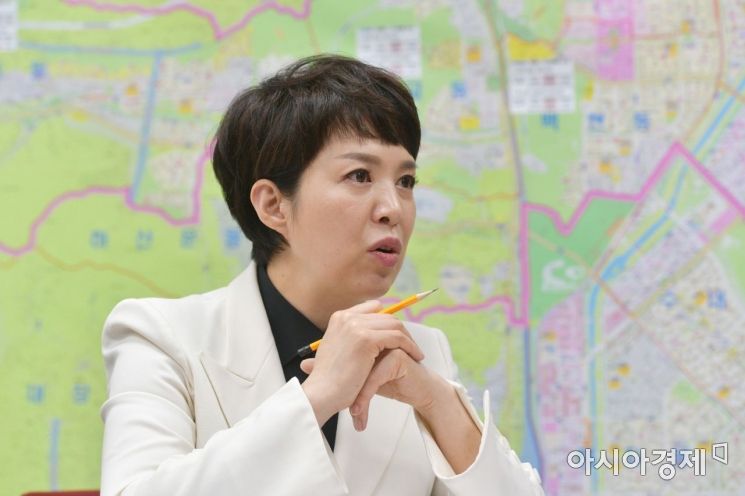
[Asia Economy Reporter Koo Chae-eun] Kim Eun-hye, a member of the People Power Party representing Daejang-dong in Bundang-gu, Seongnam, criticized Gyeonggi Governor Lee Jae-myung's preferential treatment allegations regarding Daejang-dong on the 23rd, stating, "There was a limit to Seongnam City's profits, but an infinite ceiling was set for the profits of seven individuals, which was problematic." She argued that the structure should have been designed so that Seongnam City and the private sector would receive additional dividends on excess profits beyond a certain amount. The issue was the project structure that guaranteed a "priority fixed profit" of 550 billion KRW while placing no cap on the excess profits that Hwacheon Daeyu would take and failing to reclaim them.
On the same day, Kim said on Facebook, "Some received an unprecedented windfall, while the residents of Daejang-dong, who did not properly recover development profits, live holding onto their land where not even a public parking lot or underground power transmission tower has been resolved," criticizing the situation.
Kim also stated, "There is evidence that from the time of the 2015 public offering, the Daejang-dong project was classified as a 'profitable business'." She cited the 2015 research report by Seongnam Urban Development Corporation as the basis. The report indicated that the Daejang-dong area had excellent location conditions, with good sales performance and business feasibility, and this was also noted in the investment report of Seongnam's Tteul. She pointed out that this contradicts the Open Camp's explanation that the profits were a reward for bearing investment risks.
She also evaluated that the explanation that private involvement was necessary due to restrictions on local bond issuance was unconvincing. She said, "Even if they wanted to avoid LH, there were sufficient ways to collaborate with organizations like Gyeonggi Urban Corporation to return thousands of billions in public development profits to residents."
Kim emphasized, "I will strive to restore the rights of the Daejang-dong community, which were taken away by the 400 billion KRW economic community."
However, Lee's side defends these claims by stating that "the private development method was converted to public development, securing certain profits." Lee Kyung, spokesperson for the Open Camp, emphasized, "If it had been private development, the 550 billion KRW that Seongnam City took would have all gone to the private sector," adding, "We implemented policies for the people's benefit despite being called communists by developers."
© The Asia Business Daily(www.asiae.co.kr). All rights reserved.
![From Bar Hostess to Organ Seller to High Society... The Grotesque Con of a "Human Counterfeit" [Slate]](https://cwcontent.asiae.co.kr/asiaresize/183/2026021902243444107_1771435474.jpg)
















