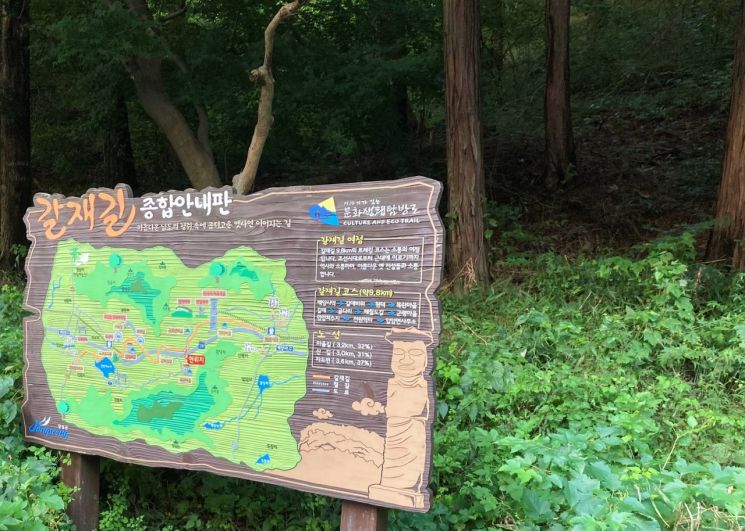
[Jangseong=Asia Economy Honam Reporting Headquarters Reporter Jo Hangyu] Jangseong-gun, Jeollanam-do (Governor Yoo Doo-seok) announced on the 23rd that the old Galjae road, which continues from Wondeok-ri, Buk-myeon to Jeongeup-si, has been preliminarily designated as a Nationally Designated Cultural Property Scenic Site.
The designated name is ‘Samnam-daero Galjae’.
The Cultural Heritage Administration recently announced the preliminary designation of a total of six old roads, including Galjae in Jangseong-gun, as Nationally Designated Cultural Property Scenic Sites.
The term ‘old road’ literally means a road that has been used since ancient times.
During the Goryeo Dynasty, these roads were mainly used for administrative purposes such as smooth movement of officials and regional division, and in the Joseon Dynasty, with the development of commerce, traffic became active.
Frequently used roads were upgraded to ‘daero’ (main roads), and at that time, the Samnam-daero, which includes Galjae in Jangseong-gun, was completed as one of nine main road systems.
These main roads connected the whole country centered on Hanyang and functioned as major civilian trade routes.
However, during the Japanese colonial period, most of these main roads lost their original form and became new roads.
Later, many of the remaining old roads were used as forest roads (rimdo), so places where the original form is preserved are rare.
The Galjae old road in Wondeok-ri, Buk-myeon, Jangseong-gun, which has been preliminarily designated as a scenic site this time, is the most representative mountain pass among the 970-ri-long Samnam-daero road that connects Hanyang to the Samnam region (Chungcheong, Jeolla, Gyeongsang provinces).
‘Galjae’ means a mountain pass with many reeds, and on old maps, it is marked as ‘Noryeong (蘆嶺)’, meaning a mountain densely covered with reeds.
This is an interesting point showing that the name of the adjacent Noryeongsan mountain range originated from Galjae.
The appearance of the old dirt and stone road is well preserved, and at the summit of the mountain pass, there remains a memorial stele (Bulmangbi, 不忘碑, 1872) engraved to remember Hong Byeong-wi, the magistrate of Jangseong.
This is an important record indicating that the Galjae old road was under the management of Jangseong-gun.
Historically, there is a record that King Hyeonjong of Goryeo crossed this pass when fleeing to Naju to escape the Khitan invasion, and during the Donghak Peasant Movement, it is said that peasants who won a great victory in the Battle of Hwangryongchon in Jangseong crossed Galjae to move to Jeongeup.
Governor Yoo Doo-seok said, “To pass on the historical value of the precious natural heritage of Galjae old road in Jangseong to future generations, we plan to establish a systematic management and maintenance plan and promote academic research after the scenic site designation.”
Meanwhile, if the Samnam-daero Galjae old road in Jangseong-gun is designated as a scenic site, the county will possess a total of 13 Nationally Designated Cultural Properties.
Jangseong=Asia Economy Honam Reporting Headquarters Reporter Jo Hangyu chg6001@asiae.co.kr
© The Asia Business Daily(www.asiae.co.kr). All rights reserved.

















