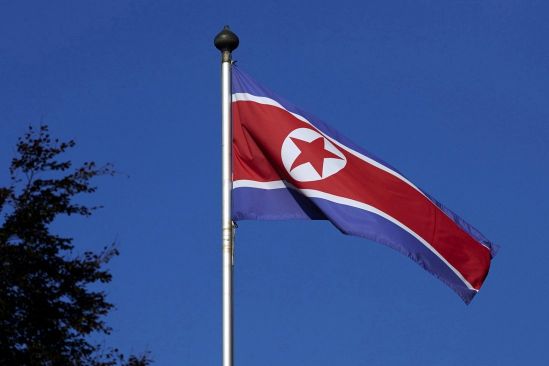
[Asia Economy Reporter Yujin Cho] The U.S. Senate has referred to North Korea as an "aggressive rogue state" and criticized it for developing weapons that threaten the United States and its allies.
On the 22nd (local time), the U.S. Senate Armed Services Committee submitted the National Defense Authorization Act (NDAA) for fiscal year 2022 to the plenary session, revealing this in an accompanying report.
The Armed Services Committee pointed out, "The United States faces threats not only from China and Russia, with whom it is engaged in strategic competition, but also from other aggressive rogue states such as Iran and North Korea, as well as terrorist organizations that pursue instability and hostility."
The committee also stated that North Korea has publicly announced plans to develop and is continuously pursuing the development of miniaturized nuclear warheads, tactical nuclear weapons, multiple independently targetable reentry vehicles (MIRVs) for missiles, and solid-fueled ballistic missiles of various ranges to threaten the United States and its allies.
However, it explained that North Korea possesses a relatively small nuclear arsenal compared to Russia or China.
Regarding Russia, it evaluated that "Russia maintains the world's largest nuclear arsenal and has modernized more than 80% of its strategic nuclear forces," and about China, it explained, "As of mid-last year, China has completed its nuclear triad (ICBM, SLBM, strategic bombers) and is expected to continue efforts to rapidly modernize and expand it."
Meanwhile, the current NDAA in the U.S. Senate does not include provisions restricting the reduction of U.S. Forces Korea (USFK) below a certain number.
From fiscal years 2019 to 2021, during the Donald Trump administration, the NDAA included provisions that prohibited using the budget to reduce the current 28,500 U.S. troops stationed in Korea.
This was Congress's check to prevent President Trump from unilaterally reducing USFK without consulting the allied country, South Korea.
The reason the restriction on reducing USFK was removed is analyzed to be because the Biden administration, which values alliances, has taken office, making such provisions unnecessary.
The NDAA passed by the House Armed Services Committee earlier this month also omitted the restriction on reducing USFK.
Instead, it included language stating that "South Korea is a very important ally of the United States," and that "the stationing of 28,500 U.S. troops in Korea is not only a force for stability on the Korean Peninsula but also a reaffirmation of security guarantees to all allies in the region," emphasizing the need to maintain USFK.
© The Asia Business Daily(www.asiae.co.kr). All rights reserved.
!["The Woman Who Threw Herself into the Water Clutching a Stolen Dior Bag"...A Grotesque Success Story That Shakes the Korean Psyche [Slate]](https://cwcontent.asiae.co.kr/asiaresize/183/2026021902243444107_1771435474.jpg)
















