Asian Stock Markets Generally Stable... Shanghai Composite Index Also Starts Slightly Up
"Uncertainty Not Completely Resolved... Need to Keep Monitoring China Evergrande Group Issues"
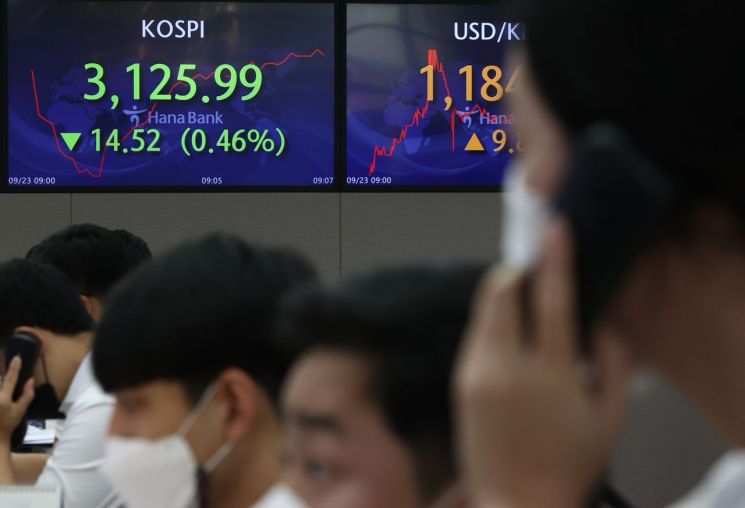 On the morning of the 23rd, the real-time KRW/USD exchange rate and KOSPI are displayed in the dealing room of the Hana Bank headquarters in Myeongdong, Jung-gu, Seoul.
 [Image source=Yonhap News]
[Asia Economy Reporters Minwoo Lee, Eunbyeol Kim] Unlike the global stock markets that plunged sharply during the Chuseok holiday period due to the bankruptcy issues of Chinese real estate developer Evergrande (恒大·Hengda) and concerns over interest rate hikes by the Federal Open Market Committee (FOMC), the domestic stock market maintained a slightly weak range and showed relatively resilient performance. However, since uncertainties have not been completely resolved, there is an analysis that close attention should be paid to the possibility of a spread to a slowdown in the Chinese economy in the future.
KOSPI Holds Up Well... Maintains Slightly Weak Range
As of 10:43 a.m. on the 23rd, the KOSPI recorded 3,125.25, down 0.49% from the previous trading day. After opening slightly weak at 3,123.64, the decline widened but it still remained within the slightly weak range. At the same time, the KOSDAQ also fell 0.36% from the previous trading day to 1,042.33. It also opened slightly weak at 1,040.38 but showed little fluctuation.
Compared to the approximately 2% drop in major U.S. indices as well as the Shenzhen Composite Index in China and the Taiwan Weighted Index following the emergence of Evergrande Group's bankruptcy issues, the domestic market is evaluated to have performed relatively well.
Evergrande Group announced in a statement on the 23rd that it would pay interest on yuan-denominated bonds maturing in September 2025, traded on the Shenzhen Stock Exchange, on time, which eased market concerns. Following this news, the Chinese stock market reversed a 1.4% decline from the previous day and closed with a 0.4% gain. Regarding the U.S. government's debt ceiling negotiations, the House of Representatives passed a bill to provide temporary funding to the federal government until December 3 and to suspend the debt ceiling until December next year, alleviating some concerns. Accordingly, on the 22nd (local time), the Dow Jones Industrial Average, S&P 500, and Nasdaq all closed up about 1% at the New York Stock Exchange (NYSE).
As of 10:27 a.m. that day, the Australian ALL ORDS index also rose 1.12% from the previous day to 7,679.10. The Shanghai Composite Index opened at 3,651.27, up 0.63% from the previous day.
Sangyoung Seo, a researcher at Mirae Asset Securities, analyzed, "Overall, with the U.S. stock market closing firmly, Evergrande Group announcing that it would initially pay interest, and the FOMC showing no surprises regarding interest rate hikes, uncertainties in Asian stock markets have somewhat eased, limiting the decline."
However, he expressed concerns that these are all temporary measures and uncertainties remain. Researcher Seo advised, "Since many individuals and small and medium-sized enterprises have purchased promissory notes issued by Evergrande Group, if this issue is not ultimately resolved, it could expand into a slowdown in the Chinese economy. Given South Korea's high export dependence on China, this could be a negative factor for the stock market, so it should be closely monitored."
Won-Dollar Exchange Rate Still Soaring
Meanwhile, the won-dollar exchange rate remains at a high level. In the Seoul foreign exchange market that day, the won-dollar exchange rate rose more than 10 won compared to just before the Chuseok holiday, reaching the 1,185 won level. The intraday high also surpassed previous peaks. The risk from Evergrande Group heightened safe-haven asset preference, and the dollar strengthened before and after the FOMC meeting results announcement overnight, which appears to have put upward pressure on the exchange rate. During the holiday, the offshore market saw the won-dollar exchange rate surge to as high as 1,190 won.
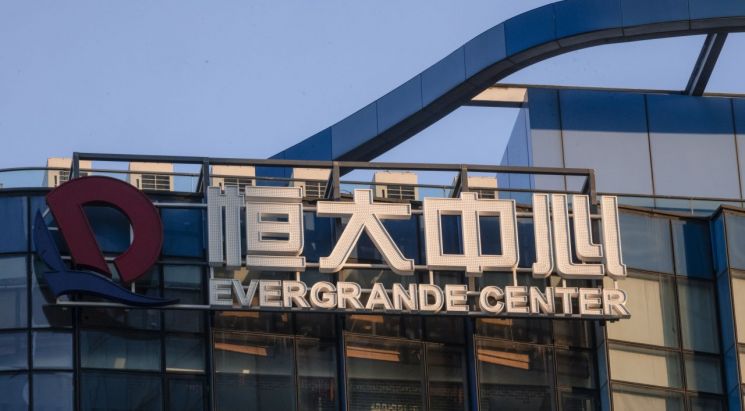
The bankruptcy rumors of China’s Evergrande Group have not subsided even after the group announced it would pay interest on some bonds on time. This is because the amount of interest promised to be paid on time is less than half of the total. Credit rating agencies’ forecasts that the Chinese government will not support Evergrande are also fueling concerns. The offshore yuan value fell to its lowest level in about a month. Recently, as the influence of the Chinese economy on South Korea has increased, the won’s value tends to move in tandem with the yuan, which inevitably has a negative impact on the exchange rate.
Interpretations that the FOMC meeting results were somewhat hawkish (favoring monetary tightening) also contributed to the dollar’s strength. Jerome Powell, Chair of the U.S. Federal Reserve (Fed), stated that tapering (reduction of asset purchases) could be decided at the next meeting, and the dot plot advanced the timing of interest rate hikes to next year. Accordingly, the dollar index surged from around 92 at the beginning of this month to the mid-93 range. Hongcheol Moon, an analyst at DB Financial Investment, said, "It seems that Evergrande and the FOMC each influenced the exchange rate by about half," adding, "Considering the trend, the exchange rate could touch 1,200 won."
© The Asia Business Daily(www.asiae.co.kr). All rights reserved.


















