Experts Divided... "Protect Actual Tenants vs Control Jeonse Prices"
Jeonse Loans Surge 14% This Year... Mortgage Loans 3.5 Times Higher
Government and Financial Authorities Struggle Over Jeonse Loans
"In the second half of this year, we have no choice but to squeeze (squeeze) jeonse loans. We will strongly manage loans for multi-homeowners or those suspected of speculation." (September 13 · Hong Nam-ki, Deputy Prime Minister for Economy and Minister of Strategy and Finance)
"We plan to review (additional household debt measures) so that actual demand borrowers are not harmed by jeonse loans and group loans." (September 16 · Ko Seung-beom, Chairman of the Financial Services Commission)
As the financial authorities plan to announce a comprehensive household debt measure next month, whether jeonse loans will be included in the regulation has become a hot topic. In the financial sector, opinions are sharply divided between those who say jeonse loans are used for gap investment (buying with jeonse) and are a cause of rising house prices, and those who argue that regulation would directly harm actual demand borrowers. Experts are also evenly split, and the government and financial authorities appear to be agonizing over the final decision.
"Actual Demand Borrowers Harm" vs "Cause of Rapid House Price Increase"
With rising house prices and jeonse prices identified as causes of increased household loans, whether to block jeonse loans, which are currently exempt from regulation, has emerged as a key issue in additional household debt measures. While it is widely observed that financial authorities lean toward the view that there is a problem with jeonse loans, experts are deeply divided. The biggest problem is that since there are many actual demand borrowers, regulation could potentially trigger a 'crisis.' In fact, jeonse loans are borrowed by tenants, but the loan amount is directly deposited into the landlord's account. Since the loan is used only for the jeonse deposit and hardly diverted for other purposes, it strongly reflects actual demand.
Professor Sung Tae-yoon of Yonsei University’s Department of Economics said, "Most jeonse loans are for actual demand borrowers," adding, "It is problematic to block loans even for those who do not have jeonse funds." He believes that accurate determination of actual demand is necessary so that loans can be provided when needed.
On the other hand, Professor Kim Sang-bong of Hansung University’s Department of Economics diagnosed, "Jeonse loans raise jeonse prices, which in turn raise house prices," and "For example, if someone rents out their own house and rents another house with jeonse, it is a kind of gap investment, so it is difficult to see everyone as actual demand borrowers."
Experts unanimously agree that accurate fact-finding is most important before the government decides on policy direction. Professor Lee Jung-hee of Chung-Ang University’s Department of Economics pointed out, "It is risky to regulate jeonse loans uniformly," and "Regulation should focus on misuse of jeonse loans beyond their original purpose, and contract conditions should be well managed." Otherwise, instead of preventing speculation, innocent victims may arise.
Professor Kim advised, "Some people take the maximum jeonse loan despite having stocks or deposit assets and invest the remaining money. Just as a funding plan is required when purchasing a house, a funding plan should also be obtained for jeonse."
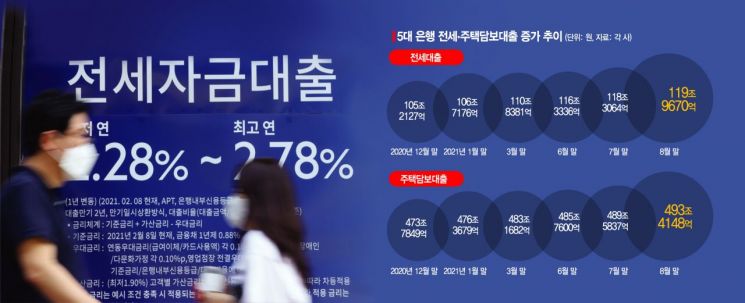
Jeonse Loans Surge 14% While Mortgage Loans Increase 4%
The reason financial authorities continue to struggle over regulating jeonse loans is the steep increase in jeonse loan amounts. Jeonse loans from the five major commercial banks rose sharply by 14.02%, from 105.2127 trillion won at the end of last year to 119.967 trillion won as of the end of August. This is about 3.5 times the increase rate of mortgage loans (4.14%) during the same period.
Especially with the autumn moving season approaching and jeonse prices expected to rise further, the scale of jeonse loans is likely to increase accordingly. According to KB Management Research Institute, last month’s jeonse price increase rate exceeded 1%, raising concerns about the jeonse market.
Considering the rapid increase in loan amounts, regulation of jeonse loans has become inevitable following mortgage loans, but financial authorities are hesitant to make a decision. There is concern that in trying to catch bedbugs (gap investors), they might burn down the whole house (actual demand borrowers).
The recent mention of possible jeonse loan regulation is largely influenced by the practice of those with spare funds borrowing the maximum amount of jeonse loans and investing the remaining money in stocks or virtual currencies. The financial authorities’ fundamental stance is that using loans for investment rather than actual demand is inappropriate.
The problem is that there is no way to verify or check how jeonse funds are actually used. Tightening jeonse loans, which are closely related to housing stability, could face strong criticism from politicians and ordinary citizens, adding to the financial authorities’ dilemma. A financial sector official pointed out, "If jeonse loans are regulated in a situation where rising house prices have already pushed up jeonse prices, criticism of real estate policy failure could intensify."
Inside and outside the financial sector, indirect methods such as strengthening screening through banks rather than tightening jeonse loan regulations are being actively discussed. This involves carefully examining during the screening process whether the borrower can afford the jeonse deposit or is using the deposit for other purposes.
© The Asia Business Daily(www.asiae.co.kr). All rights reserved.
![Clutching a Stolen Dior Bag, Saying "I Hate Being Poor but Real"... The Grotesque Con of a "Human Knockoff" [Slate]](https://cwcontent.asiae.co.kr/asiaresize/183/2026021902243444107_1771435474.jpg)

















