Chairman Powell Announces Early End to Tapering
"No Risk of China Evergrande Group Crisis in the U.S."
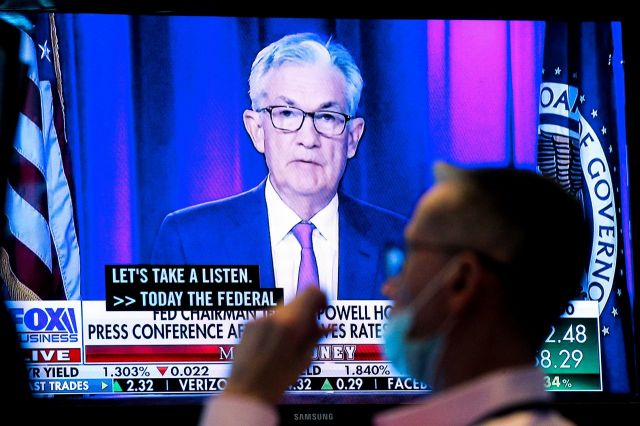 An employee of the New York Stock Exchange is watching Federal Reserve Chairman Jerome Powell's press conference on TV. [Image source=Reuters Yonhap News]
[Asia Economy New York=Correspondent Baek Jong-min, Reporter Kim Eun-byeol] The U.S. Federal Reserve (Fed) has announced plans to start tapering (reducing asset purchases) within this year. The timing for raising interest rates from the zero (0) level is also likely to accelerate.
On the 22nd (local time), the Fed announced after the Federal Open Market Committee (FOMC) meeting that it would keep the benchmark interest rate unchanged, stating, "If economic growth broadly continues as expected, it may soon be justified to slow the pace of asset purchases." Since the COVID-19 outbreak last year, the Fed has been supplying liquidity to the market by purchasing $120 billion worth of Treasury bonds and mortgage-backed securities (MBS) monthly.
Although the statement did not specify a concrete timeline, Fed Chair Jerome Powell said that employment indicators for tapering seem to have already been met and explained, "A decision could be made more easily at the next meeting." Powell also mentioned that Fed members have reached a consensus that tapering should be completed by mid-next year.
Fed members also expressed opinions that interest rate hikes will be necessary next year. In the dot plot showing Fed members' views on future rate hikes, 9 out of 18 members expected rate increases within next year.
This is an increase of 2 members from the 7 projected in June, confirming that the perception within the Fed that the timing for rate hikes should be accelerated is spreading.
Fed members also raised their core inflation forecast for this year to 3.7%, which analysts interpret as a basis for the argument that inflation response is necessary.
However, Chair Powell emphasized that tapering is not a direct signal for rate hikes to ease market concerns. Regarding the China Evergrande Group crisis, Powell stated, "Evergrande's crisis is a problem within China, and a similar situation will not occur in the U.S."
On the day, major indices on the New York Stock Exchange closed up about 1%. U.S. Treasury yields fell to 1.306%. The dollar closed stronger, supported by the tapering announcement.
On the 23rd in the Seoul foreign exchange market, the won-dollar exchange rate broke through intraday highs due to the FOMC and Evergrande Group risks. After opening at 1,183.0 won, up 8.0 won from the previous trading day, it rose to the 1,185 won level.
Domestic stock markets could not avoid weakness. The two major indices started slightly down and widened their losses over time. As of 10:23 a.m., the KOSPI was down 27.50 points (0.88%) at 3,113.01. At the same time, the KOSDAQ index fell 6.75 points (0.65%) to 1,039.37, dropping below the 1,040 level.
© The Asia Business Daily(www.asiae.co.kr). All rights reserved.

















