Police Agency Research Project Commissioned
Reflecting Various Conditions Such as Accident Causes and Traffic Volume
Review of Enforcement Speed Appropriateness by Speed Limit
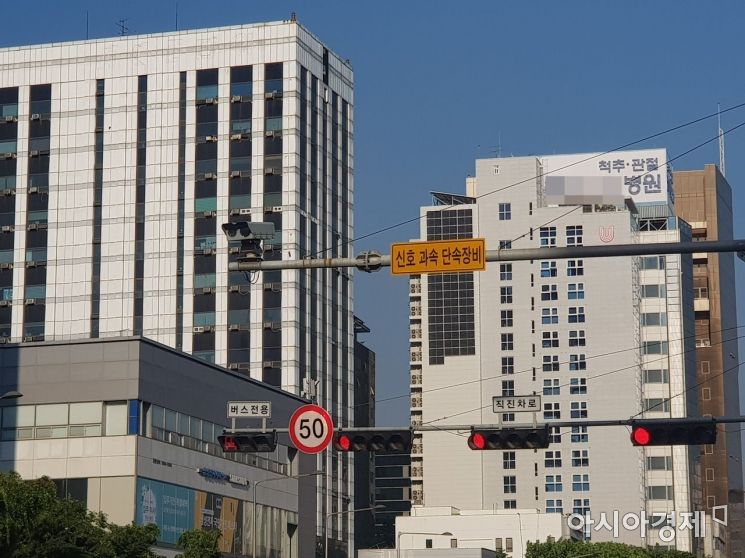
[Asia Economy Reporter Lee Gwan-joo] A plan to change the installation criteria for speed and signal violation enforcement cameras is being promoted. The current criteria only reflect the number of traffic accidents and casualties, failing to adequately consider road conditions.
According to the police on the 23rd, the National Police Agency recently commissioned a research project titled "Improvement of Installation Criteria for Unmanned Traffic Enforcement Equipment." Through this study, the police plan to review the installation criteria for unmanned enforcement equipment as well as the appropriateness of the allowable range for speed violation enforcement.
Currently, the installation of unmanned enforcement equipment is carried out according to criteria specified in the Road Traffic Act Enforcement Regulations. There are six criteria in total, with the most influential being the "Accident Risk Index (ARI)." The ARI is calculated by combining the number of deaths, serious injuries, and accident occurrences. Simply put, the higher the number of accidents and casualties at a location, the higher the risk index. The police decide the installation locations of unmanned enforcement equipment based on the combined results of the calculated risk index, on-site and road conditions, and scores from review committee members.
However, the current risk index is fundamentally limited because it is calculated solely based on the number of accidents and casualties, and does not sufficiently reflect various road environments such as accident causes, traffic volume, travel speed, and road types. As a result, it is difficult to determine how much the unmanned enforcement equipment reduces traffic accidents at the installation sites. To improve this, the police plan to develop an improved risk index that considers traffic volume, travel speed, and accident types, and also review factors necessary for installing enforcement equipment on roads such as school zones and newly constructed roads, where the current criteria yield low or no risk index.
The speed enforcement criteria for unmanned cameras currently allow a tolerance range based on error rates, and the appropriateness of this will also be reviewed. The police set allowable ranges for each speed limit by reflecting vehicle speedometer and enforcement equipment error rates. For example, in a 60 km/h enforcement zone, an error of up to 10 km/h is considered acceptable. The police plan to verify whether the current criteria are appropriate through this study and supplement objective grounds for unmanned enforcement.
© The Asia Business Daily(www.asiae.co.kr). All rights reserved.
!["The Woman Who Threw Herself into the Water Clutching a Stolen Dior Bag"...A Grotesque Success Story That Shakes the Korean Psyche [Slate]](https://cwcontent.asiae.co.kr/asiaresize/183/2026021902243444107_1771435474.jpg)
















