17 Cases of Regulatory Innovation Including Reduction of Inspection Costs for SMEs' Public Procurement and Waste Disposal Burden for Coffee Shops
[Asia Economy Reporter Lim Cheol-young] The Ministry of the Interior and Safety announced on the 23rd that it has selected 17 regulatory innovation tasks in collaboration with local governments to revitalize the regional economy, which has been stagnated due to COVID-19, and to resolve residents' difficulties, and will continuously promote them in cooperation with relevant ministries.
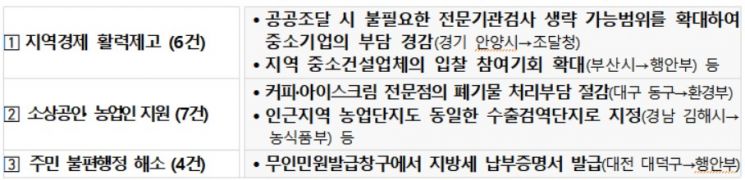
In the first half of this year, the Ministry of the Interior and Safety addressed regulatory difficulties in areas such as revitalizing the regional economy, supporting small business owners and farmers, and resolving administrative inconveniences for residents, by consulting with relevant ministries on tasks discovered by local governments. In the area of revitalizing the regional economy, six regulations were improved, including measures to reduce the burden on small and medium-sized enterprises (SMEs). In the support for small business owners and farmers, seven regulations, such as reducing the waste disposal burden for coffee specialty stores, are planned to be improved step-by-step. In resolving administrative inconveniences for residents, four issues, including issuing local tax payment certificates at unmanned civil service kiosks, are expected to be resolved.
The Ministry of the Interior and Safety first reduced the cost burden of professional inspections by public procurement specialized institutions for SMEs, following a proposal from Anyang City, Gyeonggi Province. After the inspection of procurement goods subject to professional inspection is completed, additional deliveries up to 30% of the requested delivery amount can skip the professional inspection, thereby reducing the burden on SMEs. SMEs producing procurement goods such as machinery and water pipes must pay inspection fees and have the suitability inspected by professional inspection institutions. Previously, if the additional delivery exceeded 10% of the requested delivery amount after the professional inspection was completed for the same delivery request, the additional delivery had to undergo re-inspection with payment. However, this regulatory innovation relaxed the standard to 30%, reducing time and costs for SMEs.
Accepting a proposal from Busan City, the Ministry expanded bidding opportunities for large construction projects for local small construction companies. From this year, to win bids for large construction projects over 30 billion KRW ordered by local governments, even in joint supply cases, companies must have experience participating in projects over 10 billion KRW. However, in local governments with fewer projects, only a few companies have such 10 billion KRW scale records. Therefore, to expand bidding opportunities for local small construction companies, the Ministry established an exception rule that allows the construction quality evaluation score of the representative company to be applied if there are companies with lower or no scores when ordering mandatory joint contract projects in the region.
The waste disposal burden for coffee and ice cream specialty stores will also be reduced. Following a proposal from Dong-gu, Daegu, the Ministry plans to exclude coffee and ice cream specialty stores, which have large business areas but low food waste output, from the category of ‘large food waste generators.’
Currently, food service businesses with a business area of 200㎡ or more are designated as ‘large food waste generators’ and must report food waste generation suppression and disposal plans, and comply with regulations such as outsourced waste disposal if necessary. Although coffee and ice cream specialty stores produce less food waste than restaurants of the same size, they have been subject to the same regulations, causing difficulties for small business owners. With the revision of the Enforcement Decree of the Waste Management Act, the waste disposal burden for small business owners operating coffee and ice cream specialty stores is expected to be significantly reduced.
Even if administrative districts differ, the same export quarantine complex will be designated. Until now, to export fresh agricultural products overseas, exporters had to be designated as an export quarantine complex if required by the importing country, which required grouping by administrative district. For example, the Gimhae Bugyeong paprika export agricultural complex has cultivation areas in Gimhae City and sorting centers in Busan City, so it could not be designated as a new export quarantine complex due to differing administrative districts.
The Ministry of the Interior and Safety will designate export quarantine complexes after reviewing feasibility through prior consultation between cities and counties, even if agricultural complexes are not grouped within the same administrative district, and plans to revise related notifications through local government consultations in the long term.
Following a proposal from Daedeok-gu, Daejeon, the Ministry improved the system to allow issuance of local tax payment certificates at unmanned civil service kiosks. Most civil petitioners who receive national tax payment certificates for bank loan processing also need local tax payment certificates, but unmanned civil service kiosks only issued national tax payment certificates, causing inconvenience.
To resolve the inconvenience of residents having to visit administrative welfare centers separately and wait to obtain local tax payment certificates, the Ministry plans to improve the system by January next year to allow issuance of local tax payment certificates at unmanned civil service kiosks as well.
The Ministry plans to actively discover regulations in the field in collaboration with local governments in the second half of the year and strive for prompt improvements. Park Jae-min, Director of the Local Finance and Economy Office at the Ministry of the Interior and Safety, said, “By improving regulations discovered by local governments that are in direct contact with residents and small business owners, we expect a significant sense of regulatory innovation on the ground,” and added, “We will continuously promote regulatory innovation to revitalize the regional economy, which has been stagnated due to COVID-19, and to improve the convenience of residents' lives.”
© The Asia Business Daily(www.asiae.co.kr). All rights reserved.

















