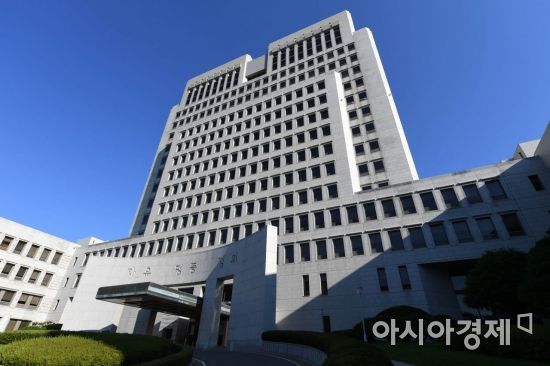
[Asia Economy Reporter Kim Hyung-min] The Supreme Court is drawing attention as it plans to introduce a conditional release system at the warrant stage. This marks the first reform of the detention system that has been in place for 67 years since the enactment of the Criminal Procedure Act in 1954.
According to the legal community on the 22nd, the Supreme Court's Judicial Administration Advisory Council has been discussing the introduction of a conditional release system at the warrant stage since March.
The Supreme Court has decided that if the Judicial Administration Advisory Council concludes to introduce the system, it will immediately proceed with the legislative process to amend the Criminal Procedure Act.
The conditional release at the warrant stage is a system where a judge, when issuing a detention warrant, attaches certain conditions such as payment of bail, residence restrictions, third-party appearance guarantees, electronic monitoring, or prohibition of contact with the victim, and releases the suspect. It is a system that introduces bail at the detention warrant issuance stage, allowing suspects to be released immediately without detention.
Currently, when the prosecution requests a detention warrant, the judge can only choose between issuing or dismissing the warrant. However, if this system is introduced, the judge can issue the warrant and then replace detention with certain conditions. This has the advantage of upholding the presumption of innocence and the principle of non-detention during investigation.
The legal community is positive about the introduction. According to a survey conducted by the Judicial Administration Advisory Council's Trial System Subcommittee in May, 81.8% of judges and 94.4% of lawyers agreed on the necessity of introducing the conditional release system.
Similar cases exist abroad. In the United States, when a suspect is arrested, they are immediately brought before the court, and at the first appearance, conditions such as a pledge or bail are set for release.
In Germany, the judge reviewing the detention warrant suspends the execution of detention by imposing measures such as providing collateral or prohibiting leaving the residence at the same time as issuing the detention warrant. France, Austria, and other countries also have systems that impose alternatives to detention, allowing suspects to be released and tried without detention.
South Korea has previously attempted to introduce a conditional release system at the warrant stage several times. After the introduction of the substantive detention warrant review system in 1997, the Judicial Reform Promotion Committee (JRPC) discussed the bail system at the warrant stage in 1999.
In 2006, the JRPC actively promoted the conditional release system at the warrant stage, and a government bill was submitted to the National Assembly. However, it was scrapped due to opposition from the prosecution. Discussions were held again in 2010 and 2017, and some lawmakers submitted related bills in 2018 and 2019, but they were not properly discussed and were discarded due to expiration of the term.
© The Asia Business Daily(www.asiae.co.kr). All rights reserved.

















