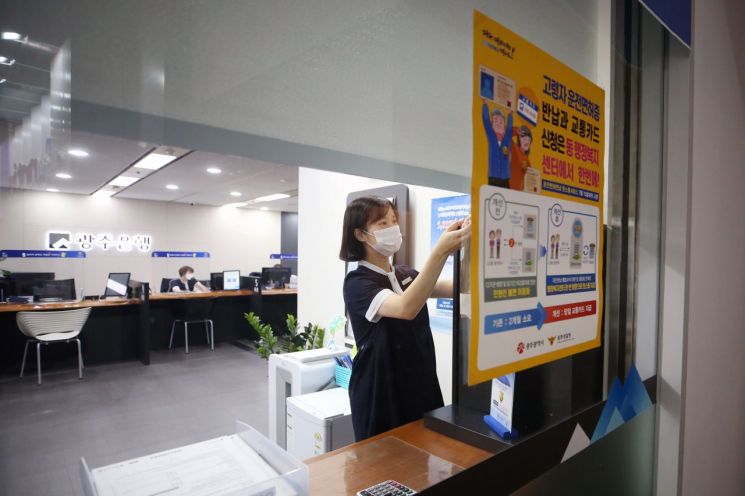
[Asia Economy Reporter Eunbyeol Kim] Since the COVID-19 pandemic, non-face-to-face financial transactions have become active, and internet and mobile banking have been revitalized, resulting in a decrease in the number of domestic bank branches and a rapid increase in IT workers in the financial sector.
According to the Financial Supervisory Service, as of the end of June, the total number of domestic bank branches was 6,326, down 79 from the end of last year. Ninety branches were closed, and 11 were newly opened.
Bank branches have been decreasing due to the expansion of non-face-to-face transactions such as mobile banking and efforts to improve branch efficiency. Last year, 304 branches were reduced over the course of one year.
Reduction in branches of commercial banks accounted for 54, or 68.4% of the total, followed by 15 for regional banks and 10 for special banks. KB Kookmin Bank and Hana Bank each reduced 18 branches. Mainly bank branches located in large cities were closed.
Financial companies are reducing the number of executives and employees along with this trend. On the other hand, as non-face-to-face financial transactions become active, they are actively securing IT personnel, and the number of IT workers in domestic financial companies exceeded 10,000 for the first time.
According to the "2020 Financial Informatization Promotion Status" published by the Financial Informatization Promotion Council, the IT personnel of 150 domestic financial companies at the end of last year was 10,265, an increase of 3.9% compared to the previous year. The survey targeted 19 domestic banks, 82 financial investment firms, 41 insurance companies, and 8 credit card companies.
During the same period, the total number of executives and employees in financial companies decreased by 3,046 (1.3%) from 228,767 in 2019 to 225,721 at the end of last year. Accordingly, the proportion of IT personnel among all executives and employees increased from 4.3% to 4.5% during the same period. The IT outsourcing personnel of domestic financial companies increased by 2.7% from 13,704 in the previous year to 14,075. The proportion of outsourcing personnel among the total IT personnel reached 57.8%. Among all respondent companies, 78.7% (118 institutions) designated and operated a Chief Information Security Officer (CISO) at the executive level. Among them, the proportion of full-time CISOs was 21.2% (25 institutions). This is another indication that financial institutions are investing heavily in IT personnel.
However, the IT budget of domestic financial companies last year was 6.9761 trillion won, a decrease of 2.7% compared to the previous year. It appears that the budget spent last year decreased as some banks completed the construction of next-generation systems in 2019.
Use of non-face-to-face finance is also increasing. The average daily usage of internet banking (including mobile banking) at domestic banks and postal finance was 13.78 million transactions and 58.8011 trillion won, increasing by 13.2% and 20.7%, respectively. The usage of "mobile trading" using smartphones recorded an all-time high. The average daily transaction amount was 26.6581 trillion won, a sharp increase of 219.6% compared to the previous year. The scale of stock trading using smartphones more than tripled in one year on a daily average basis.
© The Asia Business Daily(www.asiae.co.kr). All rights reserved.

















