OECD Interim Economic Outlook Announcement
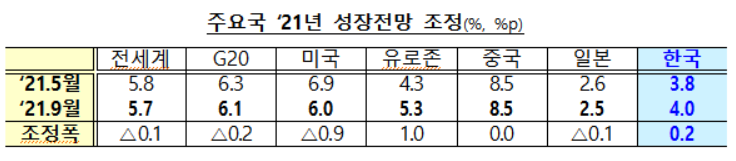
[Sejong=Asia Economy Reporter Son Seon-hee] The Organisation for Economic Co-operation and Development (OECD) projected South Korea's economic growth rate at 4.0% this year. Despite the fourth wave of COVID-19 that began in July, the OECD revised its previous May forecast (3.8%) upward by 0.2 percentage points, considering the rapid economic recovery.
On the 21st (local time), the OECD announced this through its "Interim Economic Outlook" covering the global economy and the Group of Twenty (G20), according to the Ministry of Economy and Finance. The upward revision reflects recent economic recovery achievements, as the provisional growth rates for the second quarter were each raised by 0.1 percentage points compared to the preliminary figures, following the first quarter.
With this, major institutions including the International Monetary Fund (IMF) at 4.3%, the three major credit rating agencies (S&P, Moody's, Fitch) at 4.0%, and the Bank of Korea at 4.0% have all forecast South Korea's economic growth rate to be in the 4% range this year, including the OECD.
Furthermore, comparing the average growth rate over two years from last year, when the COVID-19 crisis struck, through this year, South Korea is analyzed to rank third among G20 member countries and first among advanced economies. The Ministry of Economy and Finance explained, "This indicates that South Korea minimized negative growth last year and successfully responded to the Delta variant spread this year compared to major countries."
The OECD also revised South Korea's economic growth forecast for next year upward by 0.1 percentage points from the previous forecast (2.8%) to 2.9%. This assessment is based on the expectation that economic growth will continue to expand as quarantine measures ease following vaccination. Among G20 member countries, only four countries, including South Korea, Argentina, Mexico, and Spain, had their growth forecasts for both this year and next year revised upward.
On the other hand, the OECD downgraded growth forecasts for the global economy this year, as well as for the United States and Japan, considering the recent spread of the Delta variant. The global economic growth rate is projected at 5.7%, down 0.1 percentage points from the previous May forecast (5.8%). The United States is forecast at 6.0%, down 0.9 percentage points from the previous 6.9%, and Japan at 2.5%, down 0.1 percentage points from 2.6%. The Eurozone's economic growth rate was revised upward by 1.0 percentage point to 5.3%, while China's forecast remained unchanged at 8.5%.
The OECD explained the downward revision of the global economic outlook this year by stating, "Although recovery continues due to policy efforts and vaccination in each country, the recovery momentum is somewhat slowing," and added, "Recovery in GDP and employment by country and sector remains very uneven."
Meanwhile, the OECD revised its inflation forecast in this interim outlook, which is usually only done in the main outlooks (May and November). The G20 inflation rate is projected at 3.7%, up 0.2 percentage points from the previous forecast (3.5%), and next year's inflation is forecast at 3.9%, up 0.5 percentage points.
South Korea's inflation forecast was also raised by 0.4 percentage points from the previous forecast (1.8%) to 2.2%. Next year's inflation is projected at 1.8%, up 0.4 percentage points from the previous 1.4%. The OECD assessed that "the recent sharp rise in inflation is due to a combination of base effects, rising raw material prices, supply disruptions, and increased demand following economic reopening," and expects it to "gradually stabilize after peaking in the fourth quarter."
However, regarding the rise in South Korea's inflation forecast, the Ministry of Economy and Finance stated, "Among countries with upward revisions in growth rates, the increase in inflation is relatively small."
© The Asia Business Daily(www.asiae.co.kr). All rights reserved.

















