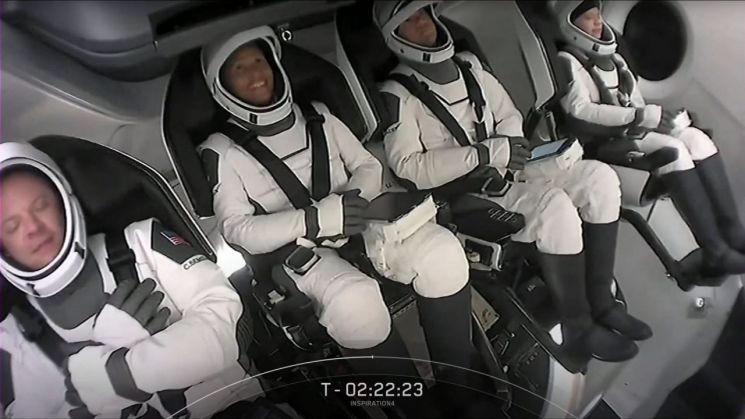
 On the 15th (local time), at Kennedy Space Center in Cape Canaveral, Florida, USA, a private space tourism group aboard SpaceX's spacecraft capsule 'Crew Dragon' waiting for launch (Kennedy Space Center AFP=Yonhap News)
[Asia Economy Reporter Kim Heung-soon] The era of commercial space tourism is unfolding as private tourists who flew in Earth's orbit aboard SpaceX spacecraft safely completed their three-day schedule and returned. The space travel industry is expected to grow to a market size of over 9 trillion won within the next decade. There are calls for South Korea to more actively foster the space industry, which will completely change the paradigm of travel and logistics and become a core infrastructure for future growth engines.
According to industry sources and foreign media on the 21st, four SpaceX space tourists flew aboard the SpaceX 'Crew Dragon' spacecraft from the 15th to the 18th local time, orbiting the Earth more than 15 times daily and splashing down in the Atlantic Ocean near Florida, USA. The spacecraft carrying them reached an altitude of 585 km, marking the farthest space reached by humanity since NASA's Apollo program ended in 1972. Having successfully completed the first space tourism, SpaceX is planning to launch up to six tourist flights per year going forward.
If air transportation carrying tourists or cargo on spacecraft rockets becomes common, the paradigm of travel and logistics is expected to be transformed. The Korea International Trade Association's International Trade and Commerce Research Institute explained in its recently published report, "Key Trends and Implications According to Changes in the Space Industry Value Chain," that by utilizing the rapid orbit of low Earth orbit, the flight time between London, UK, and New York, USA, which takes about 8 hours, can be reduced to 29 minutes, enabling same-day product delivery and same-day travel. The report also added that the space travel industry related to this is expected to grow to $8 billion (about 9.5 trillion won) within the next 10 years.
In fact, the United States allocated a budget of $50 million (about 59.5 billion won) for a super-speed military cargo transport project, proving the development potential in this field is sufficient. For SpaceX's self-produced spacecraft 'Starship,' the estimated flight times are 25 minutes between New York and Los Angeles, 27 minutes between Bangkok and Dubai, and 28 minutes between Tokyo and Singapore.
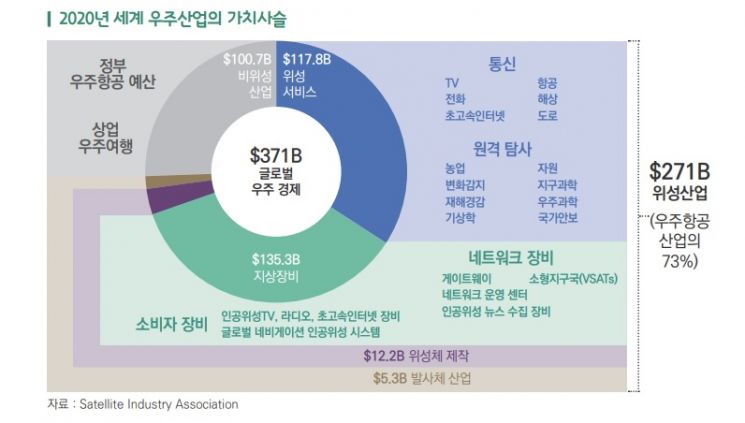 Data provided by Korea International Trade Association International Trade and Commerce Research Institute
The space industry has recently expanded significantly with increased investment and participation from private companies and large-scale projects promoted through public-private cooperation, extending its scope to commercial business models such as ultra-high-speed internet network construction using satellites, air transportation utilizing spacecraft, and space tourism. In fact, from 2009 to the second quarter of this year, 1,553 space companies invested a total of $199.8 billion (about 230 trillion won). Among them, the United States accounted for the largest share of 49.0%, followed by China (26.2%), the United Kingdom (5.1%), Singapore (4.8%), Indonesia (3.0%), and India (2.7%).
The Satellite Industry Association (SIA) of the United States forecasted that due to fierce competition for leadership among major countries, the global space industry will grow from $371 billion (about 423 trillion won) last year to $1.1 trillion (about 1,286 trillion won) by 2040. In contrast, South Korea's space industry size was about 3.8931 trillion won as of 2019, accounting for only around 1% of the global market.
Jeong Gui-il, a research fellow at the Korea International Trade Association, said, "The space industry has long been a field where innovation was stagnant, but with the entry of global companies, productivity has improved and successful business models have emerged. Private companies are enhancing competitiveness through technological and cost innovation, and the government should establish the institutional foundation necessary for growth by expanding budget support for companies' participation in space development."
© The Asia Business Daily(www.asiae.co.kr). All rights reserved.
!["The Woman Who Threw Herself into the Water Clutching a Stolen Dior Bag"...A Grotesque Success Story That Shakes the Korean Psyche [Slate]](https://cwcontent.asiae.co.kr/asiaresize/183/2026021902243444107_1771435474.jpg)

















