Federal Debt Ceiling Negotiation Stalls... Default Risk
Democrats Push Corporate Tax Cap Increase Amid Earnings Risks
US Stock Market Doubles Since Pre-COVID19... Correction Likely↑
Experts: "Market Underestimates Risks... Volatility Risk Growing"
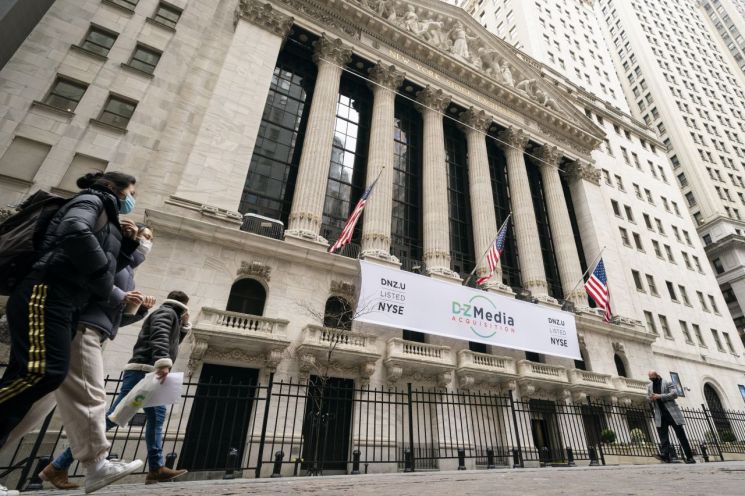
[Asia Economy Reporter Kim Suhwan] As Democratic lawmakers in the United States push for an increase in corporate tax rates on large companies, negotiations between the ruling and opposition parties over adjusting the federal government debt ceiling are facing difficulties, raising concerns about the possibility of a default. Consequently, worries are spreading that the U.S. stock market, which has shown an unprecedented rapid rally since last year, may undergo a correction.
On the 13th (local time), Democratic members of the U.S. House of Representatives decided to pursue tax increases, including raising the corporate tax cap from the current 21% to 26.5% and increasing taxes on individuals earning more than $400,000 annually in capital gains, which could significantly impact the stock prices of technology and healthcare-related companies.
Margaret Patel, a portfolio manager at Wells Fargo, emphasized, "If taxes on capital income increase, there is a possibility of a correction centered on growth stocks," adding, "It inevitably affects market value."
Meanwhile, if the U.S. Congress fails to agree on raising the federal debt ceiling during the ongoing adjustment process, the resulting default could cause the stock market to collapse.
The current government debt ceiling is set at approximately $22 trillion. In 2019, both parties agreed to temporarily suspend the debt ceiling until July 31 of this year.
However, as the suspension period approached, the parties failed to pass follow-up legislation amid conflicts over President Joe Biden's infrastructure budget plan.
Consequently, the debt ceiling was reinstated starting August 1. With federal debt already exceeding the limit, the Treasury Department has been securing necessary funds through remaining cash and emergency measures.
In response, U.S. Treasury Secretary Janet Yellen warned, "If the debt ceiling adjustment is delayed, it could negatively impact the confidence indices of businesses and consumers and may lead to a downgrade of the United States' national credit rating."
Secretary Yellen also urged Congress to adjust the debt ceiling, stating, "It will cause irreparable damage to the U.S. economy and global financial markets."
Experts believe the likelihood of an actual default is low. Nevertheless, if congressional negotiations are delayed, the resulting anxiety is expected to stimulate market volatility.
In particular, with the U.S. S&P 500 index having nearly doubled compared to pre-COVID-19 levels last year, marking the largest increase since World War II, pressure for a correction is inevitably growing.
Accordingly, concerns about market corrections and slowing growth continue to be raised, especially on Wall Street.
U.S. asset management firm BMO Wealth Management warned, "The market is underestimating risks," adding, "Over the next two months, more potential vulnerabilities and resulting volatility will emerge in the market."
Experts are also concerned about the possibility of a recurrence of the U.S. national credit rating downgrade crisis.
During the 2011 debt ceiling crisis, negotiations between the parties over adjusting the debt limit were prolonged and difficult. As a result, Standard & Poor's (S&P) downgraded the U.S. long-term government bond credit rating from AAA to AA+ for the first time in about 70 years.
Immediately after the downgrade, the S&P 500 index plunged by 17% over the course of a month.
In October 2013, during the federal government shutdown, the S&P 500 index fell about 4% over several weeks.
James Reagan, head of asset management research at U.S. financial group D.A. Davidson, pointed out, "Many variables will emerge over the next few weeks," adding, "The capital market has not fully reflected the existing risks." This means that if actual risks such as a federal government default and tax increases materialize, the impact on the market will inevitably be greater.
© The Asia Business Daily(www.asiae.co.kr). All rights reserved.

















