[Asia Economy Reporter Minji Lee] As Toyota, which has shown a passive stance on electric vehicle sales, actively enters the development of automobile batteries, there is a growing expectation that attention should be paid to the execution process going forward.
According to the financial investment industry on the 20th, Toyota's stock price increased by about 4% from 9,592 yen to 10,020 yen as of the 17th of this month. It is analyzed that Toyota's battery strategy announcement had a positive impact on the stock price.
Toyota recorded consolidated sales of 2.15 million units from April to June (Q1 of fiscal year 2022), an 85% increase compared to the same period last year, recovering to the 2019 sales level. Consolidated revenue was 7.9335 trillion yen, up 72% during the same period. Operating profit grew 708% to 997.4 billion yen, with an operating profit margin of 12.6%. By region, improvements were seen across all areas including the United States, Japan, Europe, and other parts of Asia.
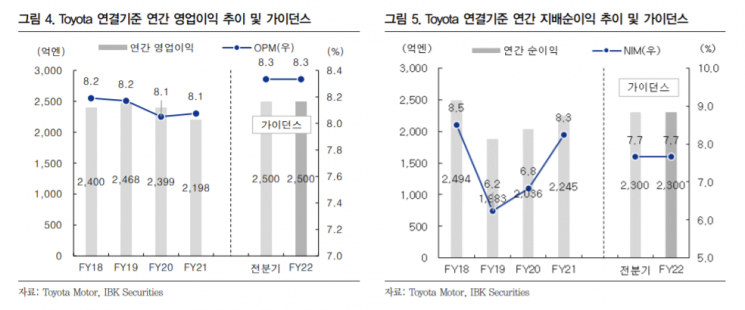
The annual guidance projected consolidated sales of 8.7 million units, 14% higher than the same period last year. Revenue is expected to increase by 10% to 30 trillion yen, and operating profit is forecasted to rise 14% to 2.5 trillion yen. The operating profit margin is expected to remain at around 8.3%, maintaining previous forecasts. Lee Sang-hyun, a researcher at IBK Investment & Securities, said, “This is due to the base effect, increased sales volume, and improved profits in the financial sector,” adding, “The guidance reflects an understanding of volatility caused by the expansion phase of the Delta variant in emerging markets, semiconductor supply shortages, and rising raw material prices.”
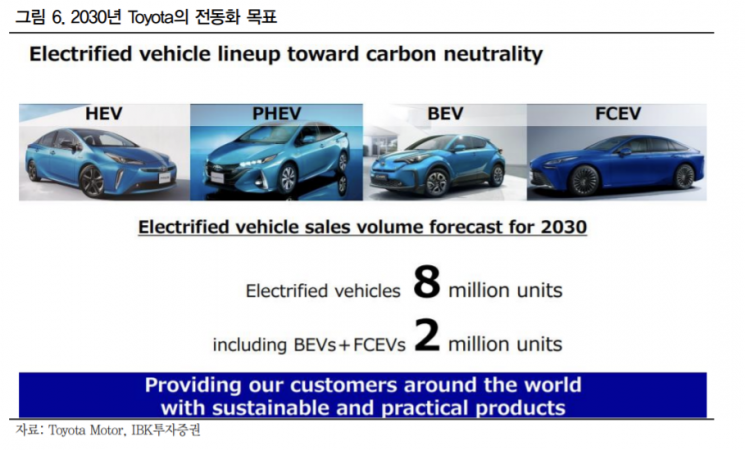
Earlier this month, Toyota announced a battery strategy for carbon neutrality, aiming to achieve full carbon neutrality by 2050 and investing 1.5 trillion yen (approximately 160 trillion won) in battery development and production by 2030. The main goals of the investment are to improve battery durability and reduce costs, commercialize solid-state batteries, and establish a flexible supply network. Toyota aims to launch electrified models across all lineups and sell a total of 8 million electrified vehicles by 2030, including 6 million HEVs and PHEVs, and 2 million BEVs and FCEVs.
Toyota identified high safety, durability, and efficiency as the key factors in battery development. To ensure safety, it analyzed the impact of various environments on batteries based on accumulated data and mentioned that the battery control system can detect and prevent abnormal overheating signs. For durability, Toyota plans to apply various technologies accumulated in HEVs to BEVs, aiming for the bZ4X model released in 2022 to maintain 90% battery capacity after 10 years of driving. Additionally, by developing low-cost materials, improving manufacturing processes, and enhancing battery structure, Toyota aims to reduce the cost per battery unit by more than 30%. Through expanding energy regeneration devices, optimizing energy and thermal management, and improving powertrain system efficiency, Toyota plans to increase battery efficiency by 30% and halve vehicle battery costs.
Solid-state batteries have advantages such as high output, long driving range, and short charging times, and completed test drives in mid-last year. Toyota plans to commercialize them in the future by improving their short lifespan. Song Seon-jae, a researcher at Hana Financial Investment, explained, “Regarding battery supply, Toyota plans to secure more than 200 GWh of supply by cooperating not only with Prime Planet Energy, a joint venture with Panasonic, but also with China's CATL, FinDream Battery (a BYD subsidiary), Japan's GS Yuasa, Toshiba, and others.”
So far, Toyota has shown a relatively slow approach to electric vehicle sales, accounting for only 1.6% of total sales and a market share of about 2.9%. Researcher Song analyzed, “This strategy is a competitiveness enhancement plan to keep up with the faster-than-expected growth of the electric vehicle market. Although the plan is relatively late, it is important to closely monitor the process as Toyota has started to move in earnest.”
© The Asia Business Daily(www.asiae.co.kr). All rights reserved.
![User Who Sold Erroneously Deposited Bitcoins to Repay Debt and Fund Entertainment... What Did the Supreme Court Decide in 2021? [Legal Issue Check]](https://cwcontent.asiae.co.kr/asiaresize/183/2026020910431234020_1770601391.png)

















