Strengthening of Jeonse Loan Regulations Expected... Aiming to Block 'Gap Investment'
Concerns Over Real Demand Buyers' Damage Spread After Regulatory Indications
[Asia Economy Reporter Kim Jin-ho] Office worker A, who is planning to get married early next year, is uneasy even during the Chuseok holiday. He had planned to secure a newlywed residence through a jeonse loan, but he heard from acquaintances and real estate communities that the government would restrict jeonse loans to reduce household loans. As a young worker, A is frustrated not only by the skyrocketing housing prices but also by the creation of a living environment where even jeonse housing is unattainable.
According to the financial sector on the 19th, financial authorities are expected to announce additional measures related to household loans after the Chuseok holiday. On the 10th, Ko Seung-beom, chairman of the Financial Services Commission, told reporters, "We will prepare supplementary measures after observing various situations post-Chuseok," adding, "Although I cannot specify details, we are conducting detailed reviews on 20 to 30 items at the practical level."
The financial sector anticipates regulations related to jeonse loans. Jeonse loans are not subject to the Debt Service Ratio (DSR) regulation and generally have relatively low interest rates. However, the financial authorities believe that non-homeowners who can cover the jeonse deposit with their own ability are taking out excessive loans to engage in debt-financed investment or gap investment (buying with jeonse), which causes side effects.
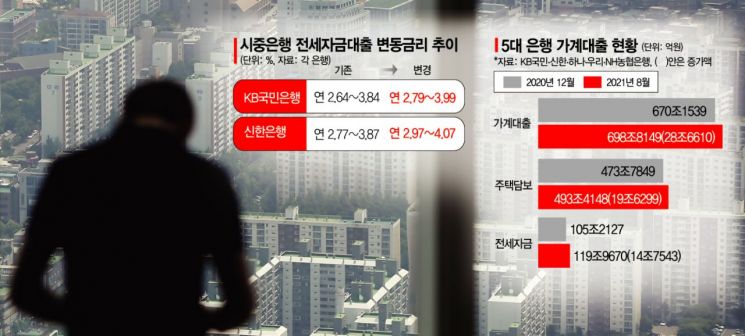
This year, the large increase in jeonse loan volume has also had an impact. As of the end of last month, the outstanding household loans of the five major banks?KB Kookmin, Shinhan, Hana, Woori, and NH Nonghyup?stood at 698.8149 trillion won, up 4.1% (28.661 trillion won) from 670.1539 trillion won at the end of last year. Among these, mortgage loans increased by 19.6299 trillion won, accounting for 68.4% of the total household loan increase. Notably, jeonse loans increased by 14.7543 trillion won, exceeding half (51.4%) of the total increase.
With measures to tighten not only mortgage and credit loans but also jeonse loans being strongly discussed, the concerns of genuine borrowers are deepening. In fact, frontline bank branches are reportedly receiving inquiries about whether to bring forward jeonse loans scheduled for the end of this year or early next year. If even jeonse loans, which are mostly for genuine demand, are blocked, the fear is spreading that not only will the dream of owning a home be crushed, but even the space to live immediately will disappear.
The financial sector raises concerns that in trying to catch bedbugs (gap investors), the thatched cottages (genuine borrowers) might be burned. A financial sector official said, "If jeonse loans, which are mostly for genuine demand, are restricted, there is a high risk of serious problems," adding, "Trying to fix some issues could result in harm to everyone."
In response, financial authorities have stated that they will prepare additional regulatory measures considering the potential harm to genuine borrowers. They plan to review regulatory proposals to prevent damage to those whose loans related to genuine demand, such as jeonse loans, group loans, and policy mortgages, have increased significantly.
However, considering that the loan growth has not been curbed despite the government's successive household debt measures, the financial sector predicts that restricting jeonse loans will ultimately be the most likely option. Another financial sector official said, "Even if there is noise, it seems that jeonse loans will eventually be restricted," adding, "At the current trend, the government’s household debt growth target (5-6%) cannot be met."
Meanwhile, financial authorities are also reportedly considering the early implementation of the DSR expansion. In April, the authorities announced a plan to gradually expand the scope of borrower-level DSR regulations, which previously applied only to specific borrowers, aiming for full implementation by July 2024 in three stages. However, as household loan growth remains unchecked, they are reportedly strongly considering early implementation of this measure.
© The Asia Business Daily(www.asiae.co.kr). All rights reserved.
![Clutching a Stolen Dior Bag, Saying "I Hate Being Poor but Real"... The Grotesque Con of a "Human Knockoff" [Slate]](https://cwcontent.asiae.co.kr/asiaresize/183/2026021902243444107_1771435474.jpg)
















