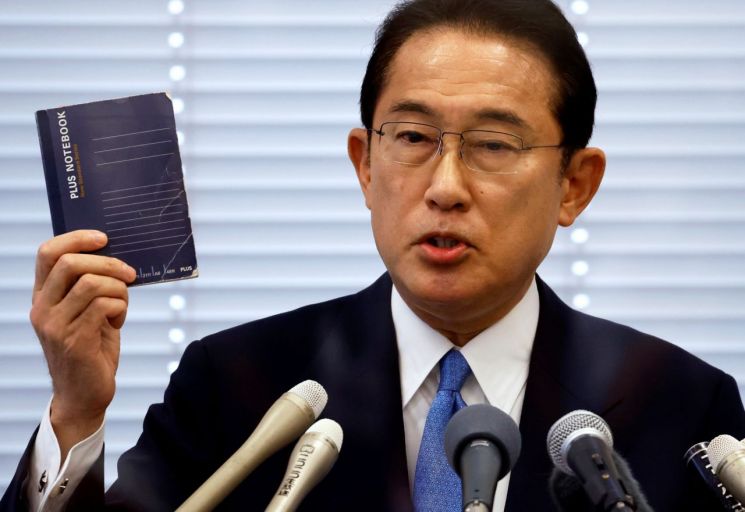
 Fumio Kishida, former Chairman of the Policy Research Council of Japan's Liberal Democratic Party
 [Photo by Yonhap News]
[Asia Economy Reporter Kim Suhwan] Fumio Kishida, former Policy Research Council Chairman of the Liberal Democratic Party (LDP) and a candidate for Japan's prime minister, stated on the 18th that the key to resolving the comfort women issue lies not with Japan but with South Korea.
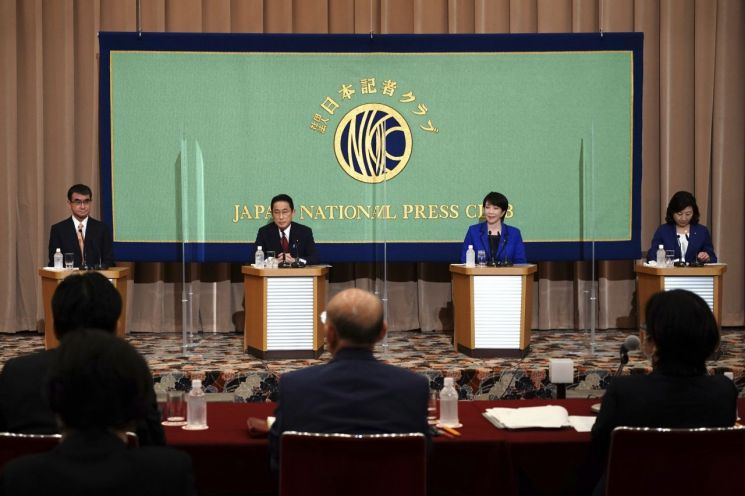
Kishida, who is running in the LDP leadership election, a gateway to becoming Japan's new prime minister, said at a candidate debate hosted by the Japan National Press Club that the "comfort women agreement" he reached with South Korea in December 2015 as Foreign Minister still holds "very significant meaning."
He claimed that the comfort women agreement, which was highly praised worldwide for its final and irreversible resolution of the issue and the mutual commitment by both countries not to criticize each other at international meetings, has been fully implemented by Japan.
He continued, saying that the current situation involves continued pressure on South Korea with the question, "What about you?" and that whether South Korea will abide by international (interstate) agreements, treaties, and international law is now under scrutiny.
Kishida said, "If (South Korea) does not even keep these, no matter what promises are made for the future, the future will not open," emphasizing the need for dialogue between the two countries but stating that "the ball is in South Korea's court" in that regard.
In December 2015, during the Park Geun-hye administration, the South Korean Foreign Minister Yun Byung-se and then Japanese Foreign Minister Kishida declared in the Korea-Japan Foreign Ministers' comfort women agreement that the issue of Japanese military comfort women was finally and irreversibly settled.
However, controversy over the exclusion of victims from the negotiation process arose immediately after the agreement, and former Prime Minister Shinzo Abe, who represented the Japanese government at the time, raised questions about the sincerity of the Japanese government regarding the agreement by stating that he had "not even thought about" sending apology letters to the victims.
As a result, the Reconciliation and Healing Foundation, established based on the agreement, was dissolved in November 2018, and the comfort women agreement effectively fell into a state of suspension.
In this context, the Seoul Central District Court Civil Division 34 ruled in January this year in favor of 12 comfort women victims, including the late grandmother Bae Chun-hee, ordering the Japanese government to pay 100 million won per plaintiff in damages. The Japanese government, which had refused to comply with the trial, abandoned its appeal, confirming the first-instance ruling and bringing the issue of compensation for comfort women victims back to the forefront of Korea-Japan diplomatic disputes.
Kishida did not mention whether he would apologize to the comfort women victims if he became prime minister during the debate.
However, at a press conference held on the 13th at the Foreign Correspondents' Club of Japan (FCCJ), he expressed a negative view on Japan continuing to apologize for its wartime acts of aggression against neighboring countries during the Pacific War.
Because of this, there is speculation that even if he becomes prime minister, it will be difficult to expect a progressive change in the Japanese government's stance on historical issues such as the comfort women dispute between Korea and Japan.
Taro Kono, who is considered a leading candidate ahead of Kishida and currently serves as Minister for Administrative Reform, stated that the fundamental principle for resolving the comfort women negotiation issue is for the South Korean government to respond properly, and emphasized the importance of both countries resolving the issue through dialogue.
Kono particularly stressed the importance of dialogue regarding export restrictions, saying, "If problems are truly occurring on the South Korean side (as claimed by the Japanese government), the measures should continue, but if the situation has been resolved, the measures (restrictions) will become unnecessary."
During the debate, questions related to diplomacy and security were focused on the two candidates, Kishida, who served as Japan's longest-serving Foreign Minister in the Abe Cabinet, and Kono, who has held both Foreign and Defense Minister posts.
Regarding North Korea's nuclear and missile development, Kishida said, "North Korea's missile technology is advancing," and mentioned the need to consider various countermeasures, including securing offensive capabilities.
On the issue of North Korea's abduction of Japanese citizens, he said all means, including direct talks, should be considered, but that confirming the Biden administration's North Korea policy and then seeking specific responses is the proper order.
Kono, who revealed that he exchanged opinions several times with North Korean counterparts while serving as Foreign Minister, said there are issues that can only be resolved at the summit level and expressed his intention to seek a summit meeting with North Korean Supreme Leader Kim Jong-un to resolve the abduction issue if he becomes prime minister.
© The Asia Business Daily(www.asiae.co.kr). All rights reserved.


















