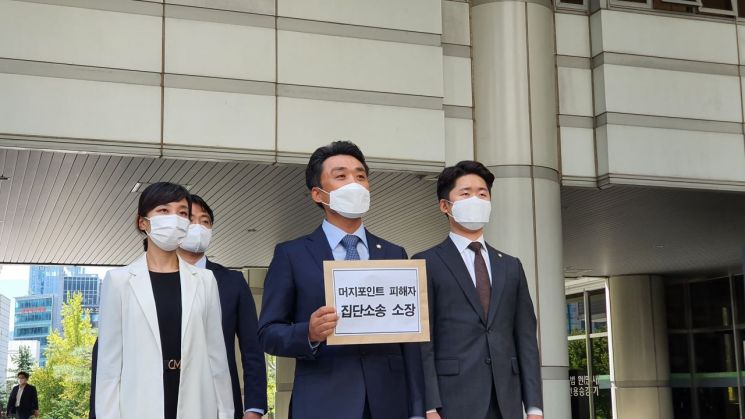
 On the 17th, the legal representatives of the Merge Point victims' class action lawsuit filed a claim for damages at the Seoul Southern District Court in Seocho-gu, Seoul, and are responding to reporters' questions. Photo by Kim Daehyun.
[Asia Economy Reporter Song Seung-seop] Victims of the Merge incident have filed a class-action lawsuit for damages against e-commerce operators who sold and mediated the products. Alongside the Ponzi scheme allegations against Merge Plus, which created and sold Merge Points, the responsibility of the e-commerce companies that earned profits through mediation is expected to become a key issue.
According to the law firm ‘Justice,’ which represents the Merge Point victims legally, a total of nine defendants are named in the complaint. These include Merge Plus Co., Ltd., Merge Support Co., Ltd., CEO Kwon Nam-hee, as well as companies registered as telecommunication sales intermediaries. The companies listed are Lotte Shopping, 11st, eBay Korea, Style C Corporation, Wemakeprice, and Tmon.
The plaintiffs total 148 people, with the claim amounting to approximately 226.8 million KRW. This sum combines 197.2 million KRW in property damages caused by purchases and subscription service payments, and 29.6 million KRW in consolation damages claimed at 200,000 KRW per victim. The Merge Point victims stated, “(Merge Plus) issued gift certificates worth hundreds of billions to trillions of won without the ability to redeem them,” and “We claim damages for illegal acts caused by fraudulent sales of gift certificates and for property and mental damages due to unilateral non-performance of services.”
On the 17th, lead attorney Kang Dong-won also submitted the complaint at the Seoul Central District Court in Seocho-gu, Seoul, stating, “Merge Plus and Merge Support show many signs of a Ponzi scheme,” and “If they sold despite having no funds from the start or running out of funds at some point, it is fraud and a civil tort.”
Merge Consumers "Purchase Inducement" vs Telecommunication Sales Intermediaries "No Negligence"
Regarding the inclusion of telecommunication sales intermediaries as defendants, it was argued that “Gift certificates are a type of debt that must inevitably be redeemed after a certain period,” and “There is an obligation to verify whether Merge Plus had the creditworthiness and lawful business structure to bear such debt.” Furthermore, “We intend to hold them accountable for inducing purchases through aggressive marketing and hot deal policies, contributing to the expansion of damages,” they added.
In court, the plan is to apply the civil legal principle of ‘joint tort liability’ to the telecommunication sales intermediaries. Joint tort liability applies when multiple parties cause damage to others. Even without prior conspiracy or intent, responsibility is recognized if there is negligence or aiding and abetting. Particularly, by holding telecommunication sales intermediaries accountable, it is explained that situations where victims win against Merge Plus but cannot recover money can be prevented.
The e-commerce companies maintain that they bear no negligence in the Merge Point incident. They argue that under current law, their role was mediation, not sales, and that there were limits to verifying other companies at the individual corporate level. A representative from an e-commerce company stated, “The operational department asked Merge Point about the Electronic Financial Transactions Act early in the sales process and heard that discussions with financial authorities were ongoing,” emphasizing, “If the contract terms were violated, we would rather sue Merge Plus.”
© The Asia Business Daily(www.asiae.co.kr). All rights reserved.

















