Frequent Price Reversals Between Apartments and Non-Apartments Due to the Pre-sale Price Ceiling System
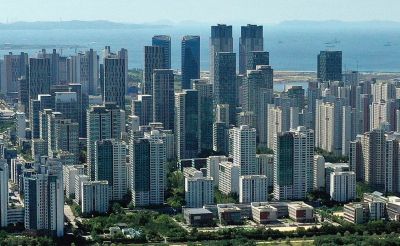 On the afternoon of the 15th, high-rise apartment buildings stand tall in Dongchun-dong and Songdo International City as seen from Cheongnyangsan in Dongchun-dong, Yeonsu-gu, Incheon.
 As apartment prices continue their relentless surge, a peculiar phenomenon is emerging where the prices of apartment alternatives such as officetels and urban-style residential housing are surpassing those of apartments, amid tightened regulations on apartments.
According to the real estate industry on the 18th, cases of price reversals between apartments and officetels within the same complex have been occurring this year. For example, in Dongtan 2 New City, Hwaseong-si, Gyeonggi Province, the officetel prices at 'Dongtan Station Dieter Prestige,' which was supplied in May-June, reached 916.6 million KRW for an exclusive area of 84㎡, about twice the price of apartments of the same size in the same complex (440.34 million to 488.67 million KRW).
Similarly, in January, the officetel prices at 'Pangyo Valley Xi' in Seongnam-si, Gyeonggi Province, ranged from 935 million to 1.073 billion KRW for an 84㎡ unit, exceeding the apartment prices of 770 million to 856 million KRW. This phenomenon arises because apartments are subject to the price ceiling system, while non-residential officetels are not, allowing their prices to be set according to market rates.
Officetels can be applied for by anyone aged 19 or older regardless of subscription savings account status, residence restrictions, or homeownership. Additionally, the loan-to-value ratio (LTV) for mortgage loans can be as high as 70% of the sale price, making entry barriers relatively low. Officetel pre-sale rights are not counted as housing when calculating acquisition tax and capital gains tax. The capital gains tax rate on the sale of pre-sale rights is also applied at the basic rate (6-45%, with a holding period condition of over 2 years).
Competition for officetel subscriptions is also heating up.
Based on data from the Korea Real Estate Agency's subscription home, real estate research firm Realtoday compiled the subscription competition rate for officetels supplied nationwide this year (as of subscription application dates). Out of 21,594 units offered, 263,969 applications were received, resulting in a competition rate of 12.22 to 1. This is about four times higher than the 3.11 to 1 rate in 2019 (12,697 units offered, 39,481 applications received).
An industry insider analyzed, "Due to regulations such as the price ceiling system reducing apartment supply and the high threshold for apartment subscriptions, those with low subscription scores are turning to officetels."
Prices of urban-style residential housing are also skyrocketing. Among the top 10 housing units by price per 3.3㎡ supplied in the Gangnam area of Seoul, eight are urban-style residential housing.
Introduced during the Lee Myung-bak administration in 2009, urban-style residential housing was designed to expand the supply of small housing units at affordable prices for low-income households without homes and single- or two-person households. Furthermore, the government exempted or relaxed regulations such as noise prevention measures, building spacing standards, and parking installation requirements to facilitate rapid supply.
According to Assemblyman So Byung-hoon (Democratic Party), a member of the National Assembly Land, Infrastructure and Transport Committee, among the top 10 projects by price per 3.3㎡ out of 1,809 projects that received pre-sale guarantees from the Housing and Urban Guarantee Corporation (HUG) since 2016, eight were urban-style residential housing projects. The 'The Sharp Banpo River Park' urban-style residential housing in Banpo-dong, Seocho-gu, Seoul, recorded the highest price at 79.9 million KRW per 3.3㎡.
Urban-style residential housing is also exempt from the price ceiling system. The Housing Act stipulates that the price ceiling system applies to multi-family housing sold on private land in areas designated as public land or speculative overheating zones where rapid price increases or subscription overheating may destabilize the market. However, urban-style residential housing is excluded from the scope of this price ceiling system.
© The Asia Business Daily(www.asiae.co.kr). All rights reserved.
![User Who Sold Erroneously Deposited Bitcoins to Repay Debt and Fund Entertainment... What Did the Supreme Court Decide in 2021? [Legal Issue Check]](https://cwcontent.asiae.co.kr/asiaresize/183/2026020910431234020_1770601391.png)















