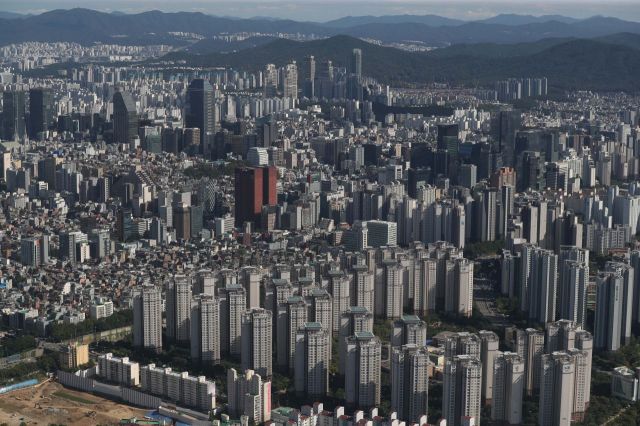
[Asia Economy Reporter Ryu Tae-min] The popularity of low-priced apartments with official prices under 100 million KRW is soaring in the real estate sales and auction markets. Demand is pouring in not only in the outskirts of the metropolitan area but also in local apartment sales and auctions in Chungnam, Chungbuk, Jeonbuk, and Gangwon provinces, leading to consecutive record-high prices and overheated competition. In particular, as the government strengthens acquisition tax and capital gains tax on multi-homeowners, investments exploiting regulatory loopholes such as indirect sales and bidding through corporations are also increasing.
According to the Korea Real Estate Board on the 19th, apartment prices in Osan, Anseong, and Hwaseong in Gyeonggi Province are rising sharply, with nearly a 1% increase per week. These three areas recorded the highest apartment price increase rates nationwide by city and county in the second week of September.
In the second week of September, the apartment price increase rate in Osan was 0.84%. Anseong was 0.83%, and Hwaseong was 0.82%. In the previous week, Hwaseong’s increase rate also reached 0.82%, showing the largest rise, while Osan and Anseong rose by 0.76% each, continuing the rapid upward trend.
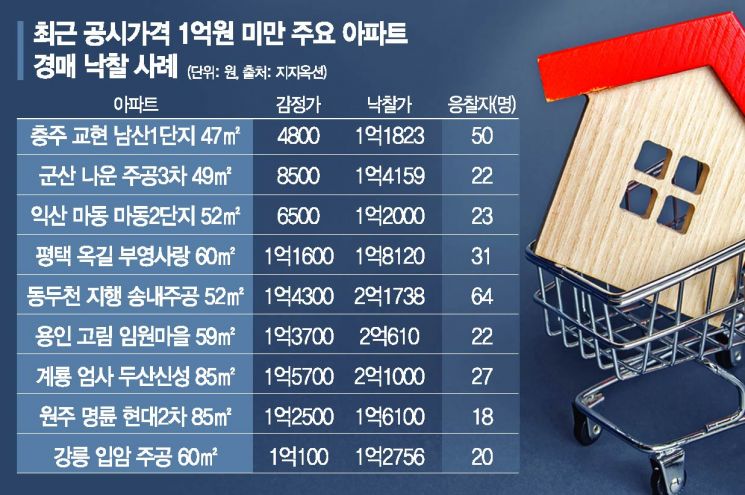
As the sales market heats up, demand is also flooding into court auctions. According to court auction specialist Gigi Auction, on June 3rd, a 52㎡ apartment in Songnae Jugong Complex 2 in Jihaeng-dong, Dongducheon-si, Gyeonggi Province, attracted 64 bidders as soon as the auction started. The property’s appraisal was conducted in August last year at 143 million KRW, which was cheaper than the market price, and since the official price was under 100 million KRW, demand surged. This property was sold at a winning bid price of 217.38 million KRW, which is 152% of the appraisal price. The winning bidder was also identified as a corporation.
The winning bid rate refers to the ratio of the winning bid price to the appraisal price. For example, if an apartment appraised at 100 million KRW has a winning bid rate of 152%, it means it was sold for 152 million KRW.
Recently, in areas with many properties under 100 million KRW such as Iksan and Gunsan in Jeonbuk and Wonju and Gangneung in Gangwon, the number of bidders often exceeds double digits. On September 2nd, a 52㎡ apartment in Madong Complex 2, Iksan-si, Jeonbuk, attracted 23 bidders and was sold for 102 million KRW, 1.5 times the appraisal price of 65 million KRW. In Ipam-dong Jugong Complex 6, Gangneung-si, Gangwon, 20 bidders participated, and the winning bid rate was 126%. Both complexes are over 30 years old.
Experts point out that the government’s layered regulations on multi-homeowners have instead created loopholes for speculative transactions by corporations. Since June 1st this year, if an individual sells a house held for less than one year, the capital gains tax rate has been strengthened to 70%, but for corporations, the maximum tax rate is only 45%, which is the basic rate (10-25%) plus an additional 20 percentage points. For example, if the capital gain is 100 million KRW, an individual must pay 70 million KRW in capital gains tax, but a corporation only needs to pay up to 45 million KRW. Because the tax rate imposed on individuals is so high, the corporate tax rate appears relatively low.
The acquisition tax is similar. The acquisition tax rate for corporations is 12% regardless of the number of houses, but if a corporation with an office outside the metropolitan area’s overconcentration control zone (all of Seoul, parts of Incheon and Gyeonggi) purchases a house with an official price under 100 million KRW, the acquisition tax rate is reduced to 1.1%.
Concerns are also emerging that overheated competition in local areas could cause side effects. Park Won-gap, Senior Real Estate Specialist at KB Real Estate, said, “There is a tendency for demand to flock to the auction market due to the perception that it is cheaper than the sales market,” adding, “However, if competition overheats and the winning bid price becomes too high, there is a risk of the ‘winner’s curse,’ so caution is needed.” Lee Joo-hyun, Senior Researcher at Gigi Auction, said, “If speculation aiming for short-term profits increases, house prices in the area could rise sharply, causing harm to local residents.”
© The Asia Business Daily(www.asiae.co.kr). All rights reserved.


















