Gyeonggi-do Confirms Subsidies for Top 12%... Payment After Chuseok
250,000 Won Per Person Paid via Local Currency
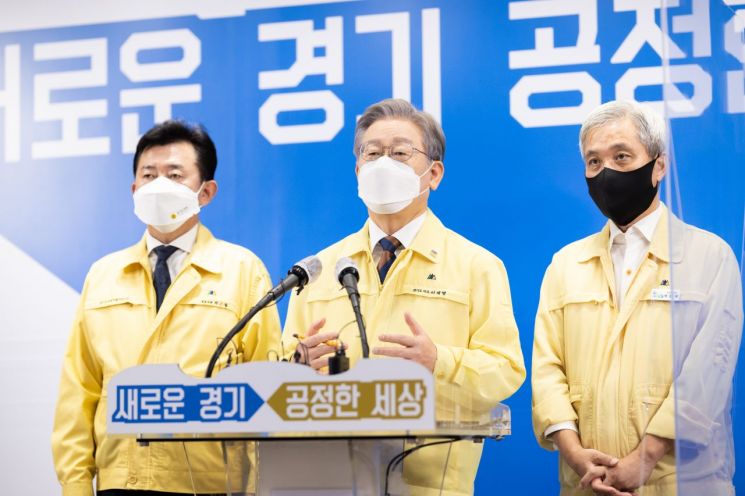
[Asia Economy Reporter Jang Sehee] "Gyeonggi-do says they will provide disaster relief funds even to the top 12%, but living in Seoul makes me feel like I'm actually losing out." Office worker Jo (32) expressed frustration over Gyeonggi-do's additional disaster relief fund payment. The issue of some people receiving support while others do not, depending on where they live, has resurfaced.
On the 15th, the Gyeonggi Provincial Council held the 354th extraordinary session plenary meeting and approved the "Gyeonggi-do 3rd Supplementary Budget," which includes the third round of disaster basic income (634.8 billion KRW) promoted by Governor Lee Jae-myung for all residents.
The third disaster basic income will provide 250,000 KRW per person in local currency and cards to residents in the top 12% income bracket who were excluded from the government's 5th disaster relief fund.
Accordingly, Gyeonggi-do will support 2.54 million high-income residents and household members excluded from the government's national support fund with 250,000 KRW per person. This includes 16,000 marriage immigrants and permanent residents.
Following Gyeonggi-do, Chungnam's Nonsan and Gyeryong also announced plans for 100% payment. As some local governments move to provide additional support funds, there is a forecast that the number of local governments offering additional payments will increase if dissatisfaction escalates.
Although everyone is struggling due to COVID-19, dissatisfaction is rising in various places as the provision of support funds differs depending on where one lives. Even if people work at the same company and have similar assets, those living in Gyeonggi-do can receive support funds, while those living in Seoul or other regions cannot.
Dissatisfaction Rising Across Incheon and Seoul... 'Disaster Relief Fund Tier Chart' Emerges
In fact, netizens have raised angry voices toward their own local governments following the news of Gyeonggi-do's additional support fund payment. They expressed opinions such as "What about Incheon?", "Other local governments should also provide to the top 12% like Gyeonggi-do. That 12% are not the rich," and "Seoul should implement the same for fairness."
On online communities, a post titled 'Disaster Relief Fund Tier Chart' is even being shared. The author classified the current national support fund recipients into five classes: Seonggol (top 3%), Jingol (top 7%), 6~4 Dupoong (top 12%), commoners (top 90%), and slaves (top 100%).
Meanwhile, controversy over the central government's "support fund for the bottom 88% income bracket" continues. As appeals surged, Deputy Prime Minister and Minister of Strategy and Finance Hong Nam-ki previously stated, "If someone is on the borderline, we will positively consider it from the citizens' perspective." If the payment rate is raised to 90%, 460,000 households, corresponding to 2% of the population, would be included. Assuming an average household size of 2.2, about 1 million additional people would be added.
© The Asia Business Daily(www.asiae.co.kr). All rights reserved.

















