"This cornerstone (Jeongchoseok) was installed on July 11, 1909, when Japanese imperialism was accelerating its invasion. The characters ‘定礎 (Jeongcho)’ were written by It? Hirobumi, the mastermind behind the invasion.
The inscription ‘隆熙三年七月十一日 (the 3rd year of Yunghee* July 11)’ is believed to have been added after liberation, but it is unknown who wrote it. This cornerstone is a trace of Japanese colonial aggression, but by preserving it, we aim to remember past wounds and take it as a lesson of history.
* The last era name of the Korean Empire used from 1907."
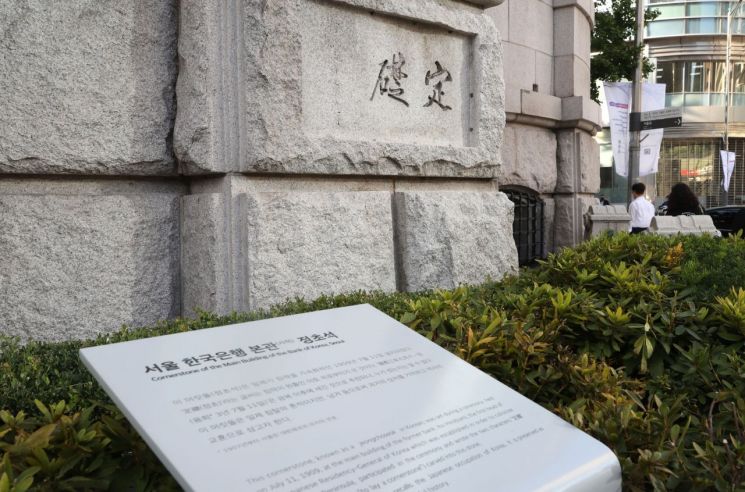
The Bank of Korea installed an information plaque containing this content in front of the cornerstone of its old main building (currently the Currency Museum) in Jung-gu, Seoul. There was much controversy over how to handle the Bank of Korea’s cornerstone, which bears the handwriting of It? Hirobumi, the first Governor-General of Korea during the Japanese colonial period. However, since it is also a lesson of history, the solution was to keep the cornerstone intact and install an explanatory plaque.
On the 15th, the Bank of Korea announced that it installed this plaque following the Cultural Heritage Administration’s policy. Last year, claims arose that the inscription on the cornerstone of the Bank of Korea’s main building was written by It? Hirobumi, and the Cultural Heritage Administration conducted an investigation through an advisory group of three experts. The investigation confirmed this to be true.
Although there was much controversy over whether to keep or remove the cornerstone until recently, the Cultural Heritage Administration decided to keep the cornerstone as is and install the plaque, and communicated the details such as the wording, size, and installation location of the plaque to the Bank of Korea.
© The Asia Business Daily(www.asiae.co.kr). All rights reserved.

















