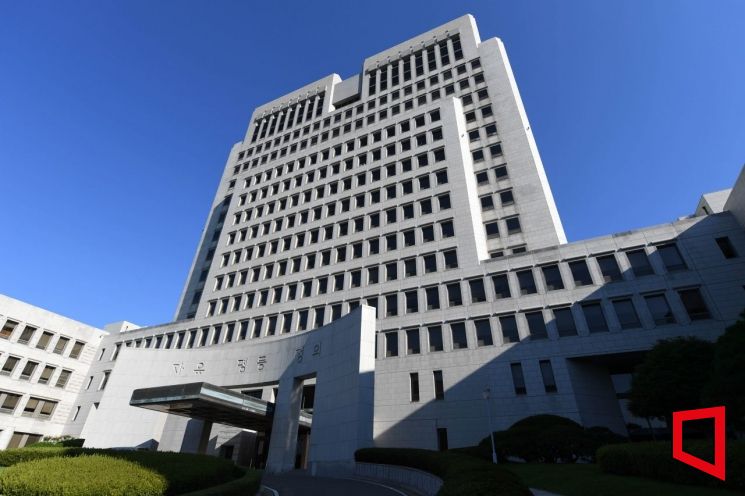
 Supreme Court, Seocho-gu, Seoul. Photo by Moon Honam munonam@
[Asia Economy Reporter Kim Daehyun] Lawyer Kwon Young-guk, who was acquitted in the first and second trials after being prosecuted for causing a disturbance in the Constitutional Court courtroom in protest of the dissolution decision of the Unified Progressive Party, will face trial again.
On the 17th, the Supreme Court Division 2 (Presiding Justice Cheon Daeyeop) announced that it overturned the acquittal verdict in the appeal trial of Lawyer Kwon, who was charged with courtroom disturbance, and remanded the case to the Seoul Central District Court.
Previously, at the end of 2014, Lawyer Kwon was prosecuted for causing a disturbance by strongly protesting in the grand courtroom of the Constitutional Court when the court issued a party dissolution decision against the Unified Progressive Party. At that time, he shouted, "The constitution has destroyed political freedom and democracy. It is the day democracy was murdered."
Article 138 of the current Criminal Act stipulates that "any person who insults or causes a disturbance in a courtroom, the National Assembly meeting hall, or nearby with the intent to obstruct or threaten court trials or National Assembly deliberations shall be punished by imprisonment for up to three years or a fine of up to 7 million won."
The first and second trials acquitted Lawyer Kwon. The first trial court stated, "It is possible to view that the defendant did not shout with the intent to obstruct the Constitutional Court's trial at that time but rather thought the verdict had been concluded and strongly expressed dissatisfaction with the result."
The second trial court emphasized, "Interpreting the scope of 'court' in Article 138 of the Criminal Act to include the Constitutional Court goes beyond the literal meaning," and "If there is a legal gap in protecting the Constitutional Court's adjudication function, it is a matter to be resolved through legislative amendment."
However, the Supreme Court ordered a retrial and reconsideration of the case. The court stated, "Considering the protected legal interests and legislative intent of Article 138 of the Criminal Act, it is difficult to see the legislative intent as excluding the Constitutional Court's constitutional adjudication function from the scope of application," and "The lower court erred in its legal interpretation regarding the meaning of court, courtroom, and trial in the crime of courtroom disturbance, which affected the verdict."
© The Asia Business Daily(www.asiae.co.kr). All rights reserved.
















