Ministry of Economy and Finance Publishes September Recent Economic Trends
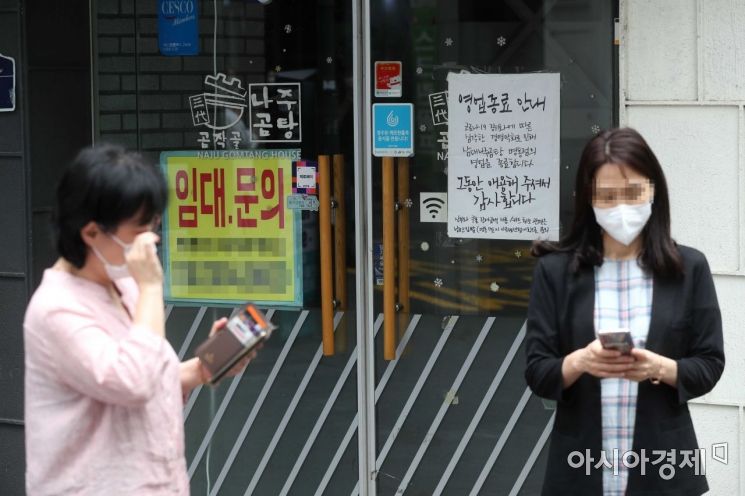 Amid the prolonged COVID-19 crisis, the debt of self-employed individuals increased by nearly 10 trillion won in the second quarter (April to June) of this year alone. According to the "2021 Q2 Depository Institutions' Industry-Specific Loan Data" released by the Bank of Korea on the 1st, the outstanding loans from deposit banks to non-corporate enterprises (self-employed) reached 418.5 trillion won at the end of the second quarter, an increase of 9.4 trillion won compared to the previous quarter. The photo shows the lifeless scene of Myeongdong on that day. Photo by Moon Honam munonam@
[Sejong=Asia Economy Reporter Kim Hyunjung] As the fourth wave of COVID-19 prolongs, the government recently diagnosed that 'uncertainty' has persisted for three consecutive months regarding the domestic economic situation. Retail sales-related indicators and consumer sentiment have somewhat contracted, affected by the resurgence of COVID-19.
On the 17th, the Ministry of Economy and Finance evaluated in the 'Recent Economic Trends September Issue' that "Recently, our economy has maintained a solid export boom, and despite the COVID-19 resurgence, employment continued to improve; however, uncertainty related to domestic demand, especially in face-to-face service industries, persists." Kim Younghoon, head of the Economic Analysis Division at the Ministry, explained, "Externally, the global economic recovery continues, supported by expanded vaccination in major countries, but concerns about inflation persist," adding, "The spread of the Delta variant has somewhat slowed the improvement of real economic indicators."
In the second quarter of this year, domestic demand showed signs of recovery with improvements in employment and consumption indicators, but as confirmed cases surged rapidly due to the fourth wave of COVID-19 in July, the government began to mention 'economic uncertainty.' Since then, the Ministry of Economy and Finance has issued nearly the same diagnosis regarding the domestic economic situation for three consecutive months from July to September.
Due to the resurgence of COVID-19, domestic retail sales-related indicators and consumer sentiment showed somewhat contraction. Department store sales increased by 14.4% compared to the previous year, expanding the improvement compared to the previous month, but offline stores such as discount stores returned to a 2.5% decline. Online sales rose by 37.4%, and card approval amounts increased by 7.2% compared to last year, but both showed a reduced growth rate compared to the previous month (45.9%, 7.9%). The consumer sentiment index recorded 102.5. After steadily rising since last December, the consumer sentiment index declined for two consecutive months following a drop in July, the first in seven months.
The number of Chinese tourists visiting Korea last month increased by only 0.9% compared to a year ago. This shows a sharp decline compared to increases of 276.3% in April, 131.4% in May, 116.3% in June, and 34.7% in July.
In August, the housing market saw an expansion in the rise of both sales prices and jeonse (long-term lease) prices. Sales prices rose by 0.96% month-on-month, increasing more than July's 0.85%, and jeonse prices also rose by 0.63% in August following a 0.59% increase in July.
Director Kim Younghoon emphasized, "To minimize economic shocks and maintain the recovery trend, we will focus on the swift execution of COVID-19 damage support measures such as the Win-Win National Support Fund, while thoroughly managing prices proactively and stabilizing people’s livelihoods."
© The Asia Business Daily(www.asiae.co.kr). All rights reserved.

















