Goal for Herd Immunity by Mid-October
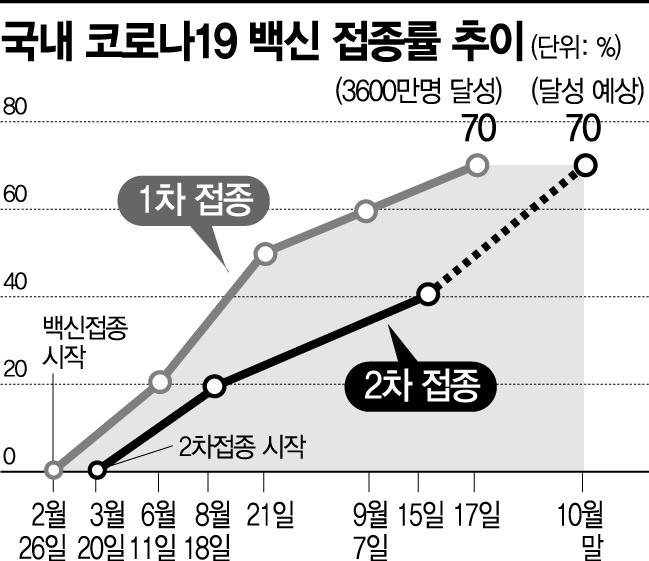
[Asia Economy Reporter Seo So-jeong] The first-dose COVID-19 vaccination rate in South Korea is expected to surpass 70% on the 17th, 203 days after the start of vaccinations. With 36 million people having received their first dose, the government plans to accelerate vaccinations to advance the goal of completing second doses by the end of October.
According to the COVID-19 Vaccination Response Promotion Team, 428,223 people received their first dose newly the day before, bringing the total cumulative first-dose vaccinations in the country to 35,414,516 as of midnight on the 17th. This accounts for 69% of the total population (51,349,116 as of last December), and it is expected to exceed 70% during the day.
Prime Minister Kim Boo-kyum stated at the Central Disaster and Safety Countermeasures Headquarters meeting held at the Government Seoul Office, "By today, 70% of the entire population will have completed their first dose," adding, "The government will now speed up the administration of second doses."
COVID-19 vaccinations in South Korea began on February 26. Although the first vaccinations started later than in countries like Israel due to delayed vaccine procurement, the country utilized its medical infrastructure to maximize vaccination speed, surpassing the first-dose rates of the United States and Japan. However, the second-dose (fully vaccinated) rate remains at 41.8% of the population, indicating the need to increase the pace.
The government aims to focus on second-dose vaccinations to bring forward the achievement of herd immunity from the end of October to mid-October. Starting today, second doses can also be administered through the leftover vaccine application within the approved vaccination interval.
Previously, only first doses could be booked using leftover vaccines, but now second doses can be reserved at desired medical institutions via Naver and Kakao apps. Pfizer can be administered 3 weeks after the first dose, Moderna after 4 weeks, and AstraZeneca between 4 to 12 weeks. However, the vaccine for the second dose must be the same type as the initially scheduled vaccine.
The government is actively considering shortening the current 6-week interval for Pfizer and Moderna vaccines to 3 weeks and 4 weeks, respectively. Kim Ki-nam, head of the Vaccination Planning Division of the Promotion Team, said, "We will shorten the vaccination intervals within the approved range while minimizing the disposal of leftover vaccines at medical institutions to vaccinate as many people as possible."
Additionally, unvaccinated individuals aged 18 and over who missed earlier opportunities can make reservations starting on the 18th and receive vaccinations from the 1st of next month. The unvaccinated population is estimated to be around 5 million, and they will receive Pfizer or Moderna vaccines. Son Young-rae, head of the Social Strategy Division at the Central Accident Response Headquarters, explained, "Considering the high willingness to vaccinate in our country, we are currently not considering mandatory vaccination measures."
Meanwhile, the number of new domestic COVID-19 cases reached 2,008, surpassing 2,000 again. The Seoul metropolitan area accounted for 1,532 cases?Seoul 738, Gyeonggi 655, Incheon 139?making up 77.6% of local transmissions, indicating a continued trend centered in the metropolitan area. In light of concerns about nationwide spread following the Chuseok holiday, Son urged, "Please minimize family gatherings during the Chuseok holiday and get tested before leaving and after returning to your hometown."
© The Asia Business Daily(www.asiae.co.kr). All rights reserved.

















