Number of Students per Teacher Similar to OECD Average
Public Education Spending at 5.1% of GDP Higher than OECD Average
Higher Education Spending at 1.6%, Showing Large Gap with Primary and Secondary Education
Government Investment in Higher Education 25% Lower than OECD Average
University Tuition Fees: 8th Highest for National/Public, 7th Highest for Private in OECD
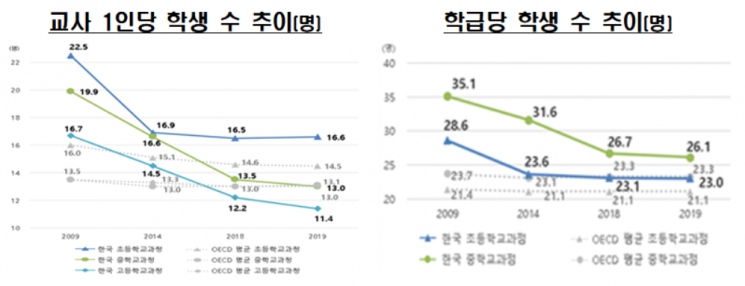
[Asia Economy Reporter Han Jinju] Although the number of students per class in South Korea is decreasing, it remains higher than the OECD average.
On the 16th, the Ministry of Education and the Korea Educational Development Institute announced key figures from the 'OECD Education at a Glance 2021,' which covers education indicators from 2018 to 2020 for OECD (Organisation for Economic Co-operation and Development) member countries.
As of 2019, the number of students per class was 23.0 in elementary schools and 26.1 in middle schools, showing a decrease compared to the previous year but still higher than the OECD average (21.1 for elementary, 23.3 for middle). Compared to the previous year, elementary schools decreased by 0.1 students, and middle schools by 0.6 students.
The number of students per teacher was 16.6 in elementary schools and 13.0 in middle schools, which is higher or similar to the OECD average (14.5 and 13.1 respectively). In high schools, it was 11.4, lower than the OECD average of 13.0. Compared to the previous year, elementary schools saw an increase of 0.1 students per teacher, while middle and high schools decreased by 0.4 and 0.9 students respectively.
Regarding this, a Ministry of Education official explained, "Teacher supply can be relatively flexible and increased as needed, but classes require physical facilities, so they are less flexible than teacher supply, resulting in a lower rate of decrease in students per class compared to students per teacher. Compared to other countries, the number of students per class in South Korea is significantly decreasing."
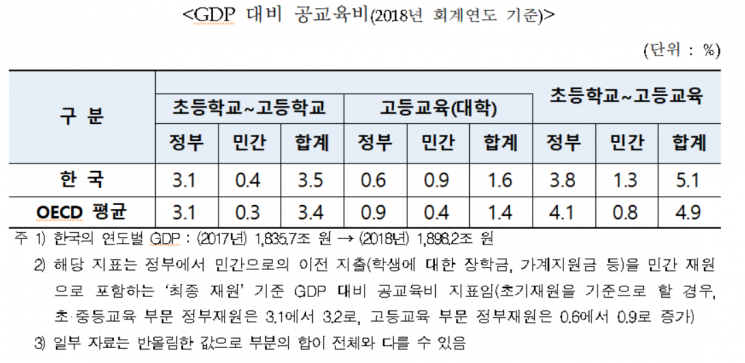
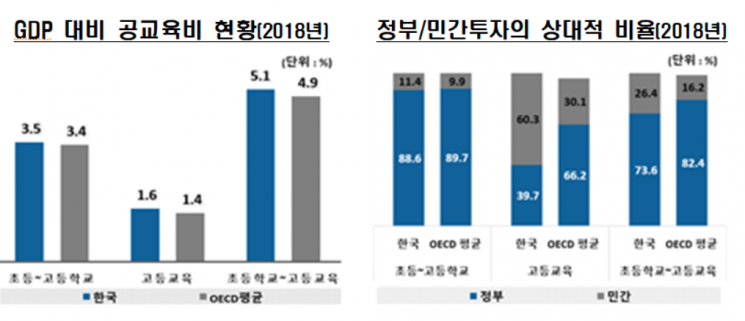
Public education expenditure as a percentage of GDP is 5.1%, higher than the OECD average of 4.9%. However, in higher education (university) it stands at 1.6%, showing a significant gap compared to the elementary, middle, and high school education curriculum (3.4%).
Among public education expenditures relative to GDP, government funding accounts for 3.8%, lower than the OECD average of 4.1%, while private funding is 1.3%, higher than the OECD average of 0.8%. The government funding ratio in higher education is only 0.6%, falling short of the OECD average of 0.9%.
The Ministry of Education explained that when government transfers to the private sector, such as scholarships or household support funds, are reflected, the proportion of government funding in public education expenditure relative to GDP increases. For elementary and secondary education, it rises from 3.1% to 3.2%, and for higher education, from 0.6% to 0.9%.
An official from the Ministry of Education said, "In countries like South Korea and Japan, the proportion of private university students is high, and the proportion of national and public university students is about 20%, which is quite low. In Europe and other regions, the state is more involved in higher education. When considering initial support such as national scholarships and household support, government investment in higher education is 0.9%, similar to the OECD average."
The relative proportion of government investment in public education expenditure from elementary school to university in South Korea was 73.6% as of 2018. Both elementary to high school (88.6%) and university (39.7%) are lower than the OECD averages (89.7% and 66.2%, respectively). Particularly, the government investment ratio related to universities shows a difference of more than 25%. In 2018, South Korea's public education expenditure per student was $12,914, an increase of $933 (8 percentage points) from the previous year, and higher than the OECD average of $11,680.
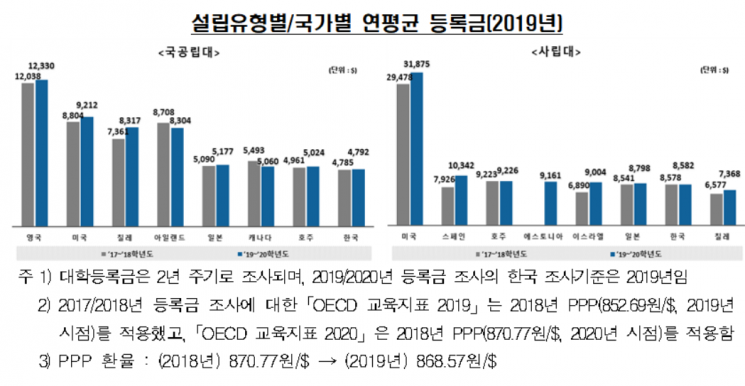
South Korea's average annual university tuition fees rank 8th highest among OECD countries for national and public universities, and 7th highest for private universities. Tuition fees for national and public universities were $4,792, showing a slight increase of 0.1 percentage points compared to 2018, while private universities were at $8,582, a similar level. Due to tuition freezes, the increase rate of private university tuition fees has become minimal, causing the ranking of private university tuition fees among OECD countries to drop four places from 4th the previous year.
Enrollment rates by age group were ▲ 93.3% for ages 3-5 ▲ 99.3% for ages 6-14 ▲ 83.9% for ages 15-19 ▲ 49.7% for ages 20-24, all higher than the OECD averages. For ages 25-29, the rate was 8.0%, lower than the OECD average. The OECD averages are 87.0%, 98.6%, 83.5%, 40.9%, and 15.5%, respectively.
The higher education attainment rate for South Korean adults (ages 25-64) is 50.7%, higher than the OECD average of 40.3%. Particularly, the youth group (ages 25-34) ranks first among OECD countries at 69.8%.
The relative wage gap by education level compared to high school graduates decreased compared to the previous year. As of 2019, graduates of junior colleges earned 108.3% (a decrease of 3.0 percentage points), university graduates 136.3% (a decrease of 2.4 percentage points), and graduate school graduates 182.3% (a decrease of 2.7 percentage points) compared to high school graduates.
The employment rate of South Korean adults by education level was 72.8%, lower than the OECD average of 75.7%. Employment rates by education level were 70.4% for high school graduates, 76.1% for junior college graduates, and 76.3% for university graduates.
The results of this survey will be posted on the OECD website in September. The Ministry of Education plans to publish a Korean translation of the OECD education indicators in December and make it available on the Education Statistics Service website.
© The Asia Business Daily(www.asiae.co.kr). All rights reserved.



















