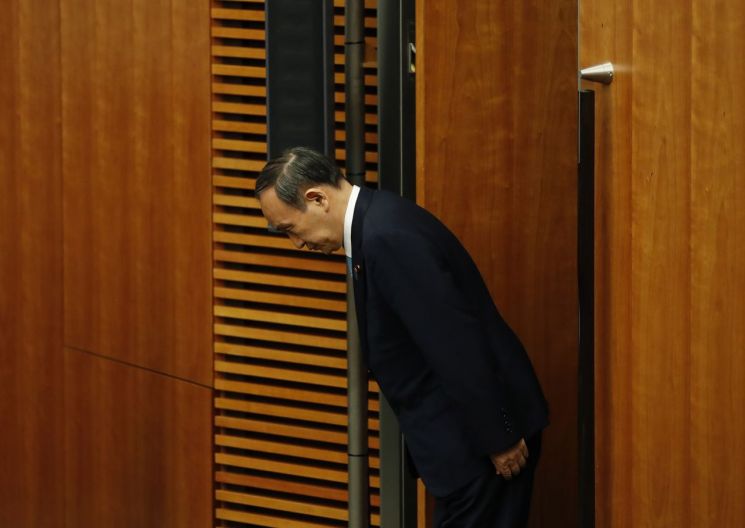
[Asia Economy Reporter Kwon Jae-hee] Japanese Prime Minister Yoshihide Suga marked a "humble" first anniversary of his inauguration on the 16th.
After securing the ruling party presidency through deals among major factions, he launched his cabinet with the third-highest approval rating among past administrations, but earlier this month, just before the anniversary, he effectively announced his resignation.
Suga, who has decided not to run in the Liberal Democratic Party (LDP) presidential election scheduled for the 29th, will hand over the prime minister position to the newly elected party president and step down.
The biggest challenge that held back Prime Minister Suga was the response to COVID-19.
Even before his inauguration, during his time as Chief Cabinet Secretary, Suga pushed forward economic stimulus measures such as the travel promotion campaign "Go To Travel," which were inappropriate given the infectious disease spread situation, and he insisted on these policies after taking office.
As confirmed cases surged, criticism grew that the Suga cabinet's flawed policies were the cause of the infection spread.
The number of new confirmed cases fluctuated repeatedly.
The COVID-19 spread worsened, and amid this, the Tokyo Olympics and Paralympics were held, increasing voter distrust toward the Suga administration.
The vaccination campaign, which Suga considered a decisive card in the COVID-19 response, stagnated for a time due to supply delays, shortage of medical personnel, and inadequate responses from administrative agencies.
A series of incidents surrounding the COVID-19 response, combined with Prime Minister Suga's lack of communication skills, accelerated the downfall of his administration.
Suga also failed to control the political situation.
In by-elections and re-elections for the House of Representatives and House of Councillors conducted under a ruling-opposition confrontation, the LDP suffered consecutive defeats.
In fact, in the mayoral election held in Yokohama, Suga's own electoral district, a close aide whom he fully supported was defeated by an opposition candidate.
The cabinet's approval rating plummeted, and public opinion within the LDP eventually turned against Suga.
With the general election approaching, a backlash spread among younger lawmakers with weak local bases, expressing that "we cannot fight the election with Suga as the party's figurehead."
Suga tried to suppress forces opposing his reappointment through cabinet reshuffles, LDP executive personnel changes, and dissolution of the House of Representatives, but faced a backlash accusing him of "recklessly trying to extend his term," leading him to announce on the 3rd that he would not run in the presidential election.
The Suga cabinet, which started with explosive popularity by highlighting his status as a non-hereditary politician and a "three no's" (no organization, no name recognition, no funds) politician, came to an end after one year.
The Nihon Keizai Shimbun diagnosed the past year by stating, "The administration was pressed by COVID-19 responses, including issuing three emergency declarations including Tokyo, resulting in low public support," but cited the promotion of administrative digitalization and decarbonization policies as achievements of the Suga cabinet.
On the 16th, marking Suga's first anniversary, the front pages of major Japanese morning newspapers were dominated by the movements of the next contenders who will push Suga out and ascend to power.
Administrative Reform Minister Taro Kono, former LDP Policy Research Council Chairman Fumio Kishida, and former Minister for Internal Affairs Sanae Takaichi have declared their candidacies for the presidential election, and former Minister for Internal Affairs Seiko Noda is reportedly rushing final preparations to run.
Suga, who rose to the prime ministership through the LDP's behind-the-scenes politics, had no opportunity to be judged by voters through a general election during his tenure.
However, the next prime minister will face direct voter judgment on the administration due to the expiration of the House of Representatives' term scheduled for the 21st of next month.
© The Asia Business Daily(www.asiae.co.kr). All rights reserved.