Government to Submit 2030 NDC Proposal to 탄중위 Including Plan to Expand Overseas Reduction Share to Over 7%
Domestic Reduction Target Increased from 151.75 Million Tons to 238.65 Million Tons to Maximize Domestic Efforts
Japan Also Raises NDC Including 7% Overseas Reduction; Switzerland Recognizes Overseas Reduction Achievements
[Sejong=Asia Economy Reporter Kwon Haeyoung] It has been confirmed that the government is considering expanding the portion of carbon reductions achieved abroad as it sets the national carbon emission target for 2030. When a specific country transfers eco-friendly technologies to developing countries or makes efforts to reduce carbon emissions such as tree planting, these efforts are recognized as greenhouse gas reduction achievements. The government plans to increase this scale to meet the carbon reduction target. Especially, with President Moon Jae-in recently proposing a national greenhouse gas reduction target (NDC) of at least 40%, which is 5 percentage points higher than the 35% stipulated by law, and the industry complaining that further domestic reductions are no longer feasible, calls for expanding overseas reductions are gaining traction.
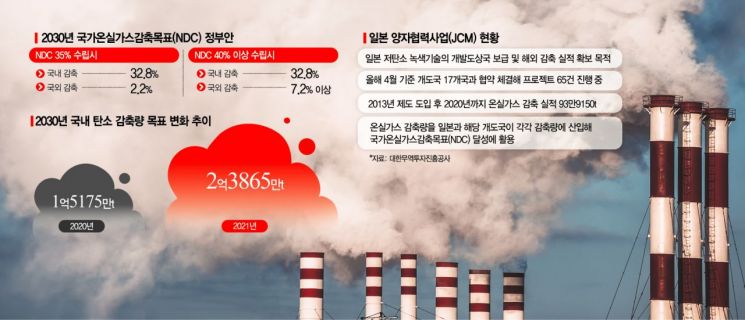
◆Government: "Expansion of overseas reductions from 2% to 7% is necessary"=According to related ministries on the 16th, the Ministry of Economy and Finance, Ministry of Trade, Industry and Energy, and Ministry of Environment submitted a government proposal to the inter-ministerial carbon neutrality control tower, the 'Carbon Neutrality Committee,' which includes reducing the 2030 NDC by 35-40% or more compared to 2018. The government proposal reportedly includes opinions that if the NDC is set at 40% or more, the overseas reduction portion should be raised to the level of Japan. Japan has set its overseas reduction portion, which involves transferring eco-friendly technologies and capital to developing countries, at 7% or more.
According to the government proposal, if the NDC is set at 35%, domestic reductions would be 32.8%, and overseas reductions 2.2%. Discussions have been held that if the NDC is raised to 40% or more, domestic reductions remain at 32.8%, while overseas reductions should be set at 7.2% or more to meet the target.
The government judged that expanding overseas reductions is inevitable because an NDC of 32.5% is seen as the margin line for achieving carbon reductions without artificial cuts by the industry. Prime Minister Kim Boo-kyum mentioned during a parliamentary economic sector question session held the day before, "The industry says that even a target in the low 30% range requires enormous investment to enable change," conveying the industry's difficulties.
The burden felt by the industry, especially in high carbon-emitting sectors like the steel industry, is very large. According to research by the Korea Institute for Industrial Economics and Trade, domestic steel demand is expected to increase from the current 72 million tons to 75 million tons by 2030. Since hydrogen reduction steelmaking technology, which produces molten iron using hydrogen instead of coal, is targeted for commercialization by 2050, achieving carbon reductions in the short term is practically difficult.
◆Japan and Switzerland also recognize overseas reductions in their NDCs=There is some opposition, mainly from environmental groups, arguing that the country is trying to easily gain recognition for reduction efforts in developing countries by leveraging technological superiority and capital without domestic carbon reduction efforts. However, based on the government proposal submitted to the Carbon Neutrality Committee last week, a simple calculation shows that the domestic carbon reduction target for 2030 increases from the existing 151.75 million tons to 238.65 million tons, an increase of 86.9 million tons.
Major countries overseas, such as Japan and Switzerland, also reflect overseas reductions in their NDCs. Japan raised its 2030 NDC in April from a 26% reduction compared to 2013 to a 46% reduction, setting the overseas reduction portion at 7% or more. The Joint Crediting Mechanism (JCM) is Japan's representative overseas carbon reduction project. It has been implemented since 2013 to promote low-carbon green technologies in developing countries and secure overseas reduction achievements. As of April this year, Japan is conducting 65 carbon reduction projects with 17 developing countries. Through this project, Japan has reduced a total of 939,150 tons of carbon until last year, and both Japan and the respective developing countries include these reductions in their NDC achievements.
Switzerland also set a goal to achieve 12.5% of its 2030 carbon reduction target (30% reduction compared to 1990) through overseas reductions. The Swiss Federal Assembly approved a carbon law amendment last year stipulating that 75% of carbon emissions reductions be domestic and 25% overseas. The Paris Agreement, which forms the binding basis for the 2030 NDC, also recognizes overseas reductions using bilateral cooperation and the Sustainable Development Mechanism (SDM) under Article 6.
The ball is now in the Carbon Neutrality Committee's court. The committee is expected to finalize the 2030 NDC next month after internal discussions based on the government proposal. Both the NDC figures and the overseas reduction portion depend on the committee's decision. President Moon will announce the final 2030 NDC at the United Nations Framework Convention on Climate Change Conference of the Parties (COP26) held in November.
Professor Cho Yongsung of Korea University’s Department of Food Resource Economics, who participates as a private member of the Carbon Neutrality Committee, said, "If the NDC is achieved easily overseas through capital and technology transfer without domestic reduction efforts, criticism is warranted. However, after maximizing domestic reduction efforts, carbon neutrality can be realized through international cooperation. Since overseas technology transfer and financial support for carbon reductions in developing countries align with the global climate crisis response, expanding the overseas reduction portion is worth considering."
© The Asia Business Daily(www.asiae.co.kr). All rights reserved.
![Clutching a Stolen Dior Bag, Saying "I Hate Being Poor but Real"... The Grotesque Con of a "Human Knockoff" [Slate]](https://cwcontent.asiae.co.kr/asiaresize/183/2026021902243444107_1771435474.jpg)
















