Ministry of Science and ICT Reveals Behind-the-Scenes Stories at Active Administration Excellence Case Presentation on the 16th
First Ever On-Site Refurbishment of Used Equipment Applied at Dutch ASML Corporation
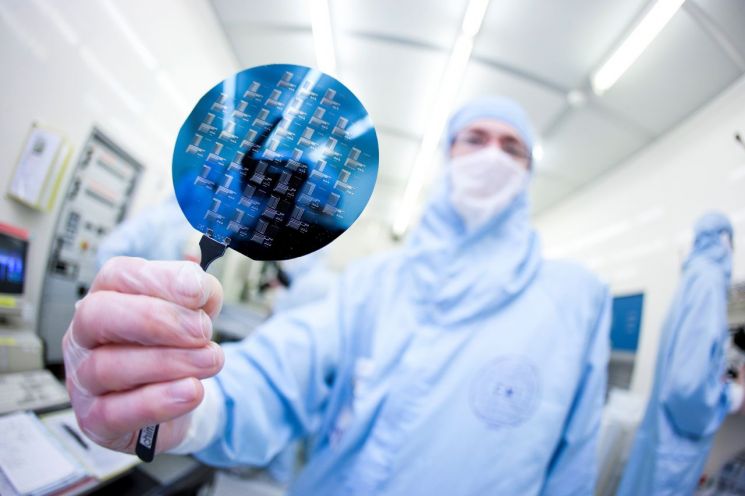
[Asia Economy Reporter Kim Bong-su] It has been reported that the government launched a major operation with Samsung Electronics and the Dutch company ASML to secure the precious 'used semiconductor core equipment, the lithography machine,' in overseas markets in response to Japan's export restrictions on key semiconductor materials.
According to the Ministry of Science and ICT on the 16th, in response to Japan's semiconductor export restriction incident in 2019, the government saw the urgent need to establish a 12-inch semiconductor testbed at the mass production line level domestically. Accordingly, a plan was promoted to install it at the Nano Convergence Technology Institute. The problem was that it was extremely difficult to obtain the core equipment, the lithography machine. This was because China, aiming for semiconductor dominance, was sweeping up used equipment in the global market.
The Ministry of Science and ICT persuaded Samsung Electronics to secure idle equipment (Arf Immersion Scanner - lithography machine) and actively negotiated and persuaded the global equipment company (ASML) to grant priority rights to secure equipment for Korea and to adopt unprecedented refurbishment methods at the installation site (Nano Convergence Technology Institute). Normally, used equipment refurbishment is conducted after being delivered to the Netherlands headquarters, but to improve the much longer time required compared to usual due to COVID-19, a groundbreaking method of refurbishing the used equipment at the installation site was applied. This shortened the testbed construction plan by 10 months and saved 5.9 billion KRW.
This fact was revealed when the Ministry of Science and ICT announced it as an 'Excellent Case of Proactive Administration' at the vice ministerial meeting held that morning. Also, when COVID-19 vaccinations for those under 50 began in July, the pre-reservation system was overloaded and became 'unresponsive,' but the issue was resolved within a few days and was also cited as an excellent case.
At that time, the Ministry of Science and ICT formed a 'Public-Private Joint Task Force (T/F)' and utilized advice and technology from private experts. They identified the causes of connection delays and stabilized the reservation system by reducing the waiting time to 2-3 minutes within a short period.
The development of the native AI doctor 'Dr. Answer' was also cited as a case of proactive administration. Although advanced medical devices were actively introduced for accurate disease diagnosis, medical staff faced increased burdens in analyzing large amounts of medical data accurately. Accordingly, the Ministry of Science and ICT improved the system by enabling the collection of medical big data scattered across various medical institutions into a highly secure cloud through proactive interpretation of existing laws and regulations.
Based on this, AI experts developed high-quality AI medical software (SW) in a short time. To verify stability and reliability, they cooperated with the Ministry of Food and Drug Safety to support rapid medical device approval. As a result, groundbreaking medical achievements such as improved diagnostic accuracy and reduced diagnosis time were confirmed during clinical verification processes at 38 domestic medical institutions. It has rapidly spread to medical sites and is currently used in actual patient care at 65 domestic medical institutions, with export negotiations underway with Saudi Arabia.
Cho Kyung-sik, the 2nd Vice Minister of the Ministry of Science and ICT, said, "Government policies should be realistic and tangible policies that can effectively address the public’s needs," adding, "To realize this, we are leading the creation of a proactive administrative culture by conducting the '2021 Proactive Administration UP Relay Challenge' and other initiatives."
© The Asia Business Daily(www.asiae.co.kr). All rights reserved.

















