 Seoul Mayor Oh Se-hoon is inspecting the Sillim 1 Redevelopment Promotion Zone site in Gwanak-gu, Seoul, on the afternoon of the 14th. Photo by Kang Jin-hyung aymsdream@
[Asia Economy Reporter Kim Hyemin] Seoul City has completed all procedures for easing redevelopment regulations and will officially begin accepting applications for candidates for the Rapid Integrated Planning from the 23rd.
On the 15th, Seoul City held an Urban Planning Committee meeting and announced on the 16th that it had finalized the "Basic Plan for Urban and Residential Environment Maintenance," which centers on abolishing the Residential Maintenance Index System and introducing Rapid Integrated Planning.
Seoul City plans to start the call for candidates for Rapid Integrated Planning on the 23rd, coinciding with the announcement date of the basic plan. The application period will last about a month, and approximately 25 sites are expected to be selected as candidates.
Rapid Integrated Planning is a system where Seoul City provides guidelines balancing public interest and business feasibility during private maintenance projects and supports swift project implementation. By omitting and simplifying step-by-step consultation procedures, the time required for district designation can be shortened from over five years to within two years.
Originally, the term "Public Planning" was to be used, but it was changed to "Rapid Integrated Planning" to avoid confusion with public-led maintenance projects such as public redevelopment and to clearly express the system's intent that the project主? is private while the public sector supports.
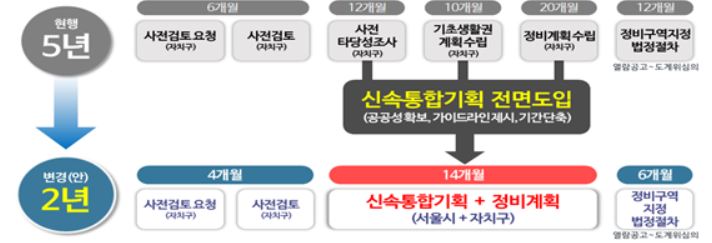
The Residential Maintenance Index System, considered an obstacle to redevelopment district designation, has been abolished after six years. Until now, even if legal district designation requirements were met, only areas satisfying "a Residential Maintenance Index score of 70 or higher and a deterioration rate of 60% or more of the total floor area" could be designated, making redevelopment thresholds high.
However, with this sudden abolition, areas that met legal requirements but were blocked by the Residential Maintenance Index System will now have opportunities for redevelopment district designation. Opportunities to participate in public redevelopment or private redevelopment under the 'Rapid Integrated Planning' system will also open.
Along with this, Seoul City has shortened the resident consent procedure from three times to two to accelerate the process. However, the resident consent rate at the early project stage (preliminary review request stage) has been raised from 10% to 30% to minimize conflicts.
A Seoul City official said, "With the abolition of the Residential Maintenance Index System, the number of sites meeting district designation requirements has increased," adding, "We will conduct annual district designation calls, considering the urgency of maintenance and balancing among districts, and gradually increase new designations while adjusting the pace."
© The Asia Business Daily(www.asiae.co.kr). All rights reserved.


















