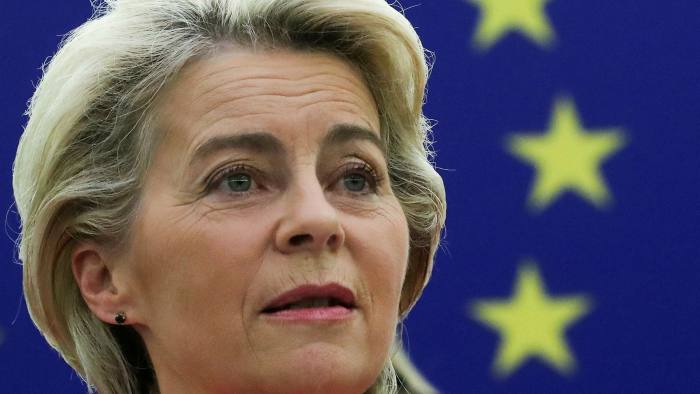
[Asia Economy Reporter Yujin Cho] The European Union (EU) has announced plans to connect the world through trade and infrastructure sectors to counter the economic and political influence gained by China through its Belt and Road Initiative.
According to Politico and others on the 15th (local time), Ursula von der Leyen, President of the European Commission, stated in her annual State of the Union address, "We will build 'Global Gateway' partnerships with countries around the world."
The Global Gateway is a trade and infrastructure investment project independently established by the EU to counter China's Belt and Road Initiative, which connects the Eurasian continent through infrastructure projects.
She said, "In this era of global hyper-competition, the EU must become a more proactive global player," adding, "Global Gateway means creating global 'connections' rather than inter-country 'dependencies.'"
Foreign media analyzed that von der Leyen's mention of dependencies was a signal of caution against the G7 leaders, led by the United States, deciding to inject massive capital into building global infrastructure to counter China's Belt and Road Initiative.
This move by the EU comes amid criticism that countries participating in China's Belt and Road Initiative are left with surplus facilities and high-interest debt, essentially falling into a debt trap. Michael Klaus, German Ambassador to the EU, emphasized, "It is important to shape globalization in the European way."
An EU senior official stated that the Global Gateway will provide value-based, transparent project financing to low-income countries beyond China's Belt and Road Initiative.
Von der Leyen stressed, "It is not reasonable for Europe to build a perfect road between copper mines and ports owned by China," adding, "We need to be smarter when it comes to such investments."
Highlighting the growing importance of the Indo-Pacific region, she said, "We will work together to deepen trade connections, strengthen global supply chains, and develop new investment projects in green and digital technologies."
Von der Leyen also added that she would propose measures to ban products made with forced labor from the EU market. This targets allegations that China forcibly mobilizes the Uyghur minority in the Xinjiang Autonomous Region to produce export goods.
She stated, "25 million people are threatened and coerced into forced labor," and "We cannot tolerate them making goods under duress and these goods being sold in European stores."
In addition, von der Leyen emphasized the importance of semiconductors in her speech and announced plans to introduce a new 'European Chips Act.'
She mentioned the global semiconductor shortage, the decline of Europe's share from design to production capacity, and dependence on Asian products, noting that this is not merely an EU competitiveness issue but also a matter of technological sovereignty.
She explained that it is necessary to connect world-class research, design, and testing capabilities within the EU and coordinate investments among individual member states, with the goal of this law being to jointly create a European chip ecosystem with the latest technology.
Regarding defense issues, she said it is time to move to the next stage and announced that when France assumes the rotating EU presidency next year, she will convene a European Defense Summit together with President Emmanuel Macron.
© The Asia Business Daily(www.asiae.co.kr). All rights reserved.
![Clutching a Stolen Dior Bag, Saying "I Hate Being Poor but Real"... The Grotesque Con of a "Human Knockoff" [Slate]](https://cwcontent.asiae.co.kr/asiaresize/183/2026021902243444107_1771435474.jpg)
















