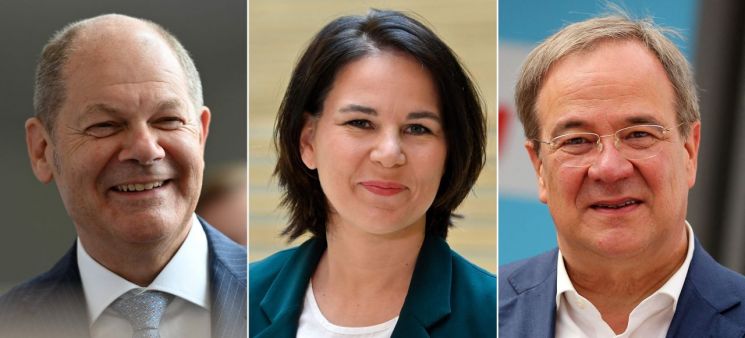
 From the left, Olaf Scholz, SPD Chancellor candidate; Annalena Baerbock, Green Party Chancellor candidate; Armin Laschet, CDU/CSU Chancellor candidate
 Photo by AFP Yonhap News
ㅗ
[Asia Economy Reporter Park Byung-hee] With the German general election just over 10 days away, the proportion of undecided voters who have yet to decide which party to support has reached an all-time high of 40%, making it difficult to predict the election outcome prematurely, major foreign media reported on the 14th (local time).
According to a poll released on the same day by the conservative German daily Frankfurter Allgemeine Zeitung, commissioned to the German polling institute Allensbach Institute, only 60% of voters who have decided to participate in the election said they had already decided which party to support. This means that 40% of voters who intend to vote have not yet decided which party to support. This proportion of undecided voters is much higher compared to 24% in the 2013 general election and 35% in the 2017 general election.
Two-thirds of the undecided voters said the reason they had not decided on a party was because the chancellor candidates did not inspire trust. Several respondents also said they had not made a decision because many things could happen before election day. Some expressed concerns about not being sure how the parties they want to support would act in future coalition negotiations.
In a situation where the proportion of undecided voters is high, the gap in support rates between the first and second parties is also narrowing.
Earlier, in a poll conducted by Forsa commissioned by RTL/n-tv and released on the 13th, the Social Democratic Party (SPD) maintained its lead with 25% support. However, the SPD's support rate showed no change compared to the previous survey. Meanwhile, the support rate for the second-place Christian Democratic Union/Christian Social Union (CDU/CSU) alliance rose by 2 percentage points to 21%. Following were the Green Party, emphasizing environmental issues, with 17%, the pro-business Free Democratic Party (FDP) with 11%, the far-right Alternative for Germany (AfD) with 11%, and the far-left Left Party with 6%.
Foreign media predicted that based on current support rates, a so-called "traffic light" coalition government composed of the SPD, the Greens, and the FDP is possible. They also added that a coalition scenario involving the left-leaning SPD, Greens, and Left Party is possible. It is highly likely that the SPD will create a government again after 16 years.
However, foreign media also reported that it is possible for the current ruling CDU/CSU alliance to form a coalition with the FDP and the Greens. Since the combined support rate of the CDU/CSU alliance, FDP, and Greens currently stands at 49%, which could be a majority, it is interpreted that the Greens and FDP, who are likely to be the third and fourth largest parties, may hold the casting vote and choose coalition partners between the SPD and the CDU/CSU alliance, who are competing for first place.
However, foreign media added that all parties want to avoid forming a coalition with the far-right AfD.
Germany will hold the general election on the 26th.
© The Asia Business Daily(www.asiae.co.kr). All rights reserved.

















