Selected as a Partner by 5 Private Companies
Developing Reusable Landers and More
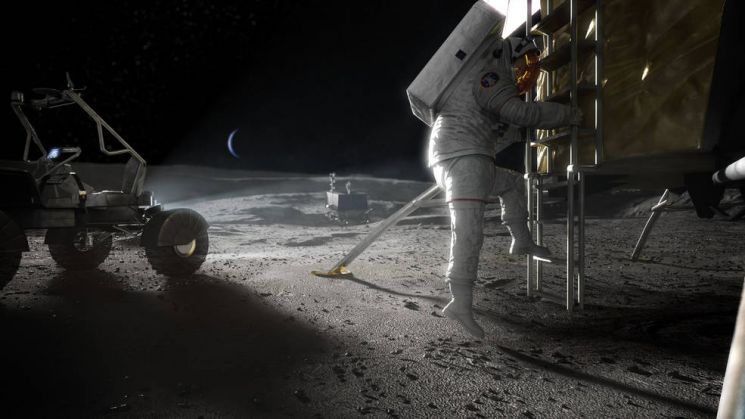
[Asia Economy Reporter Kim Bong-su] NASA announced on the 15th that it has selected five private companies as partners to build systems such as sustainable landers for long-term lunar development.
The five companies are Blue Origin ($25.6 million), Dynetics ($40.8 million), Lockheed Martin ($35.2 million), Northrop Grumman ($34.8 million), and SpaceX ($9.4 million), carrying out contracts totaling $146 million. The goals include developing concepts for sustainable crewed landing systems, conducting risk reduction activities, and fostering industrial capabilities for crewed lunar landing missions.
Specifically, these five companies will research and develop design concepts, performance, design and construction standards, mission assurance requirements, interfaces, safety, crew health management, and medical facilities for lunar landers and submit them to NASA. They are also tasked with minimizing lunar landing risks through performance testing and verification of key technologies.
NASA plans to use the research results from these five companies for regular transport missions between lunar orbit and surface in the long term. This project is separate from the second human lunar landing scheduled for 2024.
NASA stated, "The goal is to become one of the services available for multiple customers in the lunar transport market, enabling safe and cost-efficient long-term travel to and from the lunar surface," adding, "Most of the technologies developed for lunar landing will also be utilized for future Mars exploration."
Meanwhile, the United States landed humans on the moon six times through the Apollo program in the 1960s and 1970s, but the program was neglected due to political reasons such as the end of the Cold War. However, since the 2010s, interest in lunar resource development has increased, and through the Artemis program, the U.S. is actively pursuing the second human lunar landing, LunaGate, long-term lunar surface habitation facilities, and exploration and development of water and resources. The U.S. plans to include female and minority astronauts in the 2024 crewed lunar landing. John Kim, a Korean immigrant, is on the preliminary list.
© The Asia Business Daily(www.asiae.co.kr). All rights reserved.

















