Research Team of Professor Seojin Su at DGIST

[Asia Economy Reporter Kim Bong-su] Domestic researchers have, for the first time, identified how a genetic risk factor that increases the likelihood of developing Alzheimer's dementia by 5 to 10 times actually causes the disease.
The Daegu Gyeongbuk Institute of Science and Technology (DGIST) announced on the 15th that Professor Seo Jin-su's research team in the Department of Brain and Cognitive Sciences has, for the first time, elucidated the pathological mechanism by which astrocytes carrying the genetic risk factor APOE4 cause Alzheimer's dementia.
The APOE4 gene is one of the strongest genetic risk factors for Alzheimer's dementia. It is known that individuals with the APOE4 genotype have a 5 to 10 times higher risk of developing Alzheimer's dementia compared to those with the commonly observed APOE3 genotype. However, the exact mechanism by which APOE4, primarily expressed in astrocytes, induces pathological phenomena has not yet been determined. In particular, since the APOE4 genotype is not observed in experimental animals, there have been limitations in creating and utilizing accurate models.
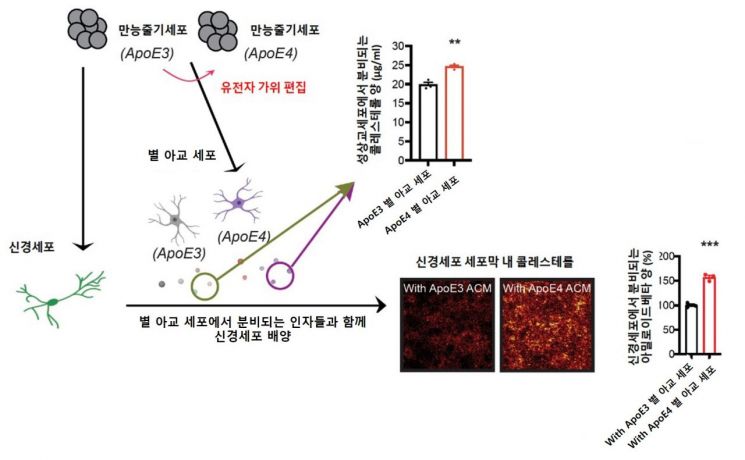
The research team applied gene-editing technology to human-derived pluripotent stem cells to produce brain cells with the APOE4 genotype and the control APOE3 genotype, and explored the role of APOE4 astrocytes in the production of amyloid beta in neurons. As a result, they observed that excessive cholesterol is secreted from APOE4 astrocytes, which causes an increase in amyloid beta secretion by neurons. Furthermore, they discovered that the increased cholesterol secretion from APOE4 astrocytes promotes amyloid beta production by enhancing the formation of lipid rafts in the neuronal cell membrane.
Professor Seo stated, “Through this study, by revealing the process by which the APOE4 genotype and astrocytes contribute to amyloid beta production in neurons, we have suggested a new direction for Alzheimer's dementia research,” and added, “We expect that extended research will propose new therapeutic targets and control methods.”
The results of this study were published online on the 26th of last month in the international journal ‘Stem Cell Reports.’
© The Asia Business Daily(www.asiae.co.kr). All rights reserved.


















