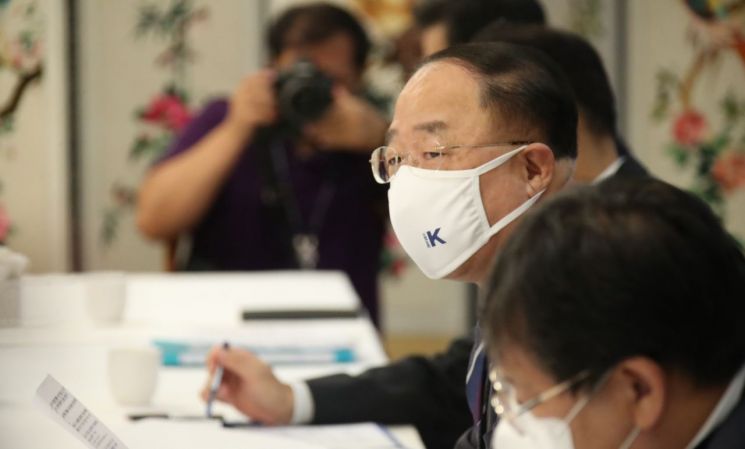
Hong Nam-ki, Deputy Prime Minister, Chairs the 30th Real Estate Market Inspection Meeting on the 15th
"Private sector role is very important for supply... Will gather industry opinions to resolve difficulties"
[Sejong=Asia Economy Reporter Kim Hyun-jung] Despite warnings of 'house price adjustments' following base interest rate hikes, real estate market prices have risen, prompting the government to emphasize the role of private supply and introduce regulatory relaxation measures. In particular, the government plans to improve the pre-sale price ceiling system, which has been identified as a major cause of market distortion, and ease regulations on non-apartment properties such as officetels. This is interpreted as an effort to actively address market difficulties and promote the role of the private sector.
Hong Nam-ki, Deputy Prime Minister and Minister of Strategy and Finance, chaired the real estate market inspection meeting with related ministers at the Government Seoul Office in Gwanghwamun on the morning of the 15th. He stated, "The role of the private sector is very important to expedite the supply of already announced housing quantities and to secure additional supply capacity." He added, "We have repeatedly collected and accumulated opinions from experts and the industry, and we will strive to resolve the raised difficulties through two approaches: expanding urban housing supply and accelerating the supply speed of apartments."
◆ Regulatory easing targeting private supply of officetels and apartments = The government plans to expand the supply of 'apartments,' which have concentrated demand in the real estate market, and focus on responding to housing demand for one- to two-person households. To this end, it plans to revise the pre-sale price ceiling system of the Housing and Urban Guarantee Corporation (HUG), which has been criticized for distorting market prices through physical regulations.
Deputy Prime Minister Hong said, "To increase the speed of apartment supply, we will improve unreasonable parts of HUG's high-priced housing management system and pre-sale price ceiling system for pre-sale price reviews." He emphasized, "The integrated permit review for administrative procedure simplification will be made mandatory in principle, moving from optional application." He continued, "To activate urban housing supply that can respond to housing demand for one- to two-person households and contribute to short-term housing supply, we will boldly ease unnecessary regulations such as area standards and floor heating for non-apartments, and strengthen financial and tax support for developers."
He also hinted at additional measures related to household loan management. He said, "The government will strongly promote already announced measures such as strengthening DSR (Debt Service Ratio) and actively explore additional measures to block balloon effects to the non-bank sector if necessary." He added, "However, during this process, we will manage to minimize the impact on actual demand rental loans." The non-bank sector referred to by the government includes savings banks, securities companies, and card companies.
He further stated, "Household loans increased by 8.5 trillion won in August, narrowing the increase compared to the previous month (15.3 trillion won), but still remain at a high level compared to before COVID-19." He added, "We will continue to closely monitor loan trends and implement more meticulous management until the loan growth stabilizes."
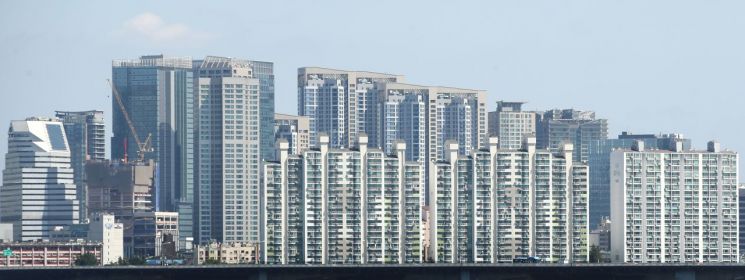
◆ Utilizing Jeonwolse (monthly rent) reporting information... Addressing contract gaps = The government plans to reduce the gap between renewal contracts and new contracts through additional responses by continuously utilizing the increasing Jeonwolse reporting information.
Deputy Prime Minister Hong said, "We intend to consider various measures to stabilize Jeonwolse prices and alleviate market difficulties by the end of the year after collecting opinions from market experts and research institutions." He added, "76.9% of tenants with renewal contracts sign at an increase rate of 5% or less, showing the effect of the introduction of the renewal right. However, on the other hand, some gaps between renewal contracts and new contracts have been confirmed, indicating the need for comprehensive market inspection and supplementary responses."
Regarding the Jeonwolse reporting system implemented since June, Deputy Prime Minister Hong diagnosed, "Since its implementation, a total of 290,000 cases have been reported by August, with the number of reports increasing every month, and the volume of Jeonwolse information (transaction volume) is also on the rise." The combined volume of Jeonwolse information from reports and issuance of confirmed dates through the reporting system was 615,260 cases from June to August this year, a 13% increase compared to the same period last year.
© The Asia Business Daily(www.asiae.co.kr). All rights reserved.


















