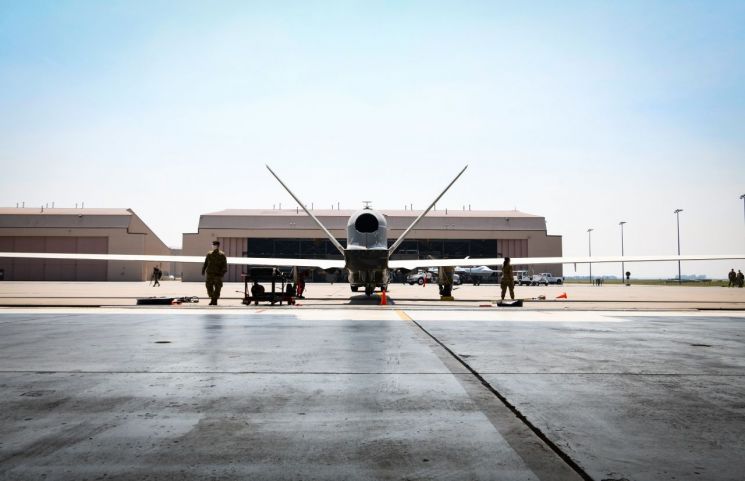
[Asia Economy Yang Nak-gyu, Military Specialist Reporter] The high-altitude unmanned reconnaissance aircraft Global Hawk will attempt hypersonic flight. In July, a retired Global Hawk at Grand Forks Air Force Base in North Dakota was modified to be used as a hypersonic new technology test platform.
According to defense company Northrop Grumman on the 15th, the U.S. government requested the modification of four retired Global Hawk (Block 20) aircraft. Northrop Grumman plans to move these aircraft to the Grumman Grand Sky facility for modification and then deploy them for hypersonic new technology tests to be conducted over the Pacific Ocean.
The Global Hawk is equipped with the Battlefield Airborne Communications Node (BACN) system, serving as an airborne base station. The U.S. Air Force's 319th Reconnaissance Wing introduced four Global Hawk (Block 20) aircraft in 2011 and has flown them for about 10,000 hours annually. Currently, they operate 8 to 9 aircraft of the Global Hawk Block 30 and Block 40 models.
The U.S. Air Force's Global Hawk recently flew over the Korean Peninsula to detect signs of North Korea's preparations for a military parade. It flew east-west over Gyeonggi and Gangwon provinces near the Military Demarcation Line (MDL), monitoring indications such as ballistic missile launches mounted on Transporter Erector Launchers (TEL) and nuclear-related activities.
Our military also introduced four Global Hawks last year and established a Tactical Exploitation of National Capabilities Processing and Exploitation Dissemination (TCPED) system. Previously, the Air Force held a ceremony to establish the 39th Reconnaissance Wing in Chungju, Chungbuk, which operates five types of aerial surveillance and reconnaissance assets including the Global Hawk, tactical reconnaissance aircraft RF-16, Geumgang reconnaissance aircraft, and domestically developed medium-altitude unmanned aerial vehicles (MUAV).
© The Asia Business Daily(www.asiae.co.kr). All rights reserved.

















